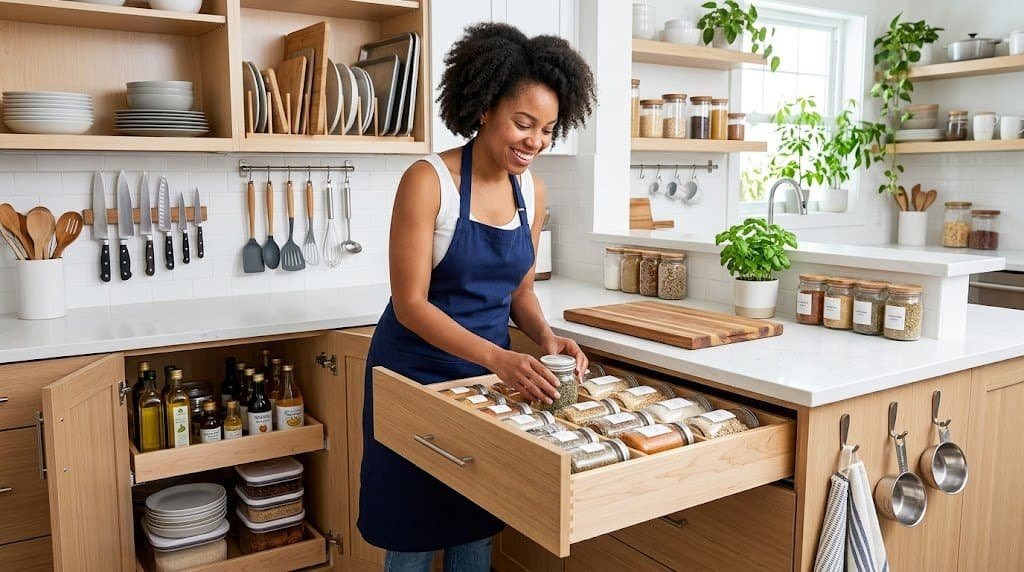
Looking for kitchen organization hacks that genuinely transform your space rather than just looking pretty in photos for a week before falling apart? You’re in the right place. Most kitchens — even beautiful, expensive ones — suffer from the same chronic problem: there’s never quite enough storage, and the storage that exists rarely matches the way you actually cook and live. The result is overflowing cabinets, drawers you can’t close, countertops cluttered with appliances you use weekly, and the special kind of frustration that comes from knowing exactly which Tupperware lid you need but being unable to find it.
In this guide, you’ll discover 20 clever kitchen storage ideas that work in real homes, not just staged photo shoots. Whether you’re trying to organize a small kitchen with limited cabinet space, optimize a galley layout, or finally bring order to a bigger kitchen that somehow still feels chaotic, you’ll find practical solutions here that you can implement this weekend. We’ll cover everything from drawer organization and cabinet hacks to creative use of vertical space, hidden storage tricks, and the small habits that actually keep an organized kitchen organized over time.
Pin this guide to your “Kitchen Decor & Organization” board so you can come back to it as you tackle each project!
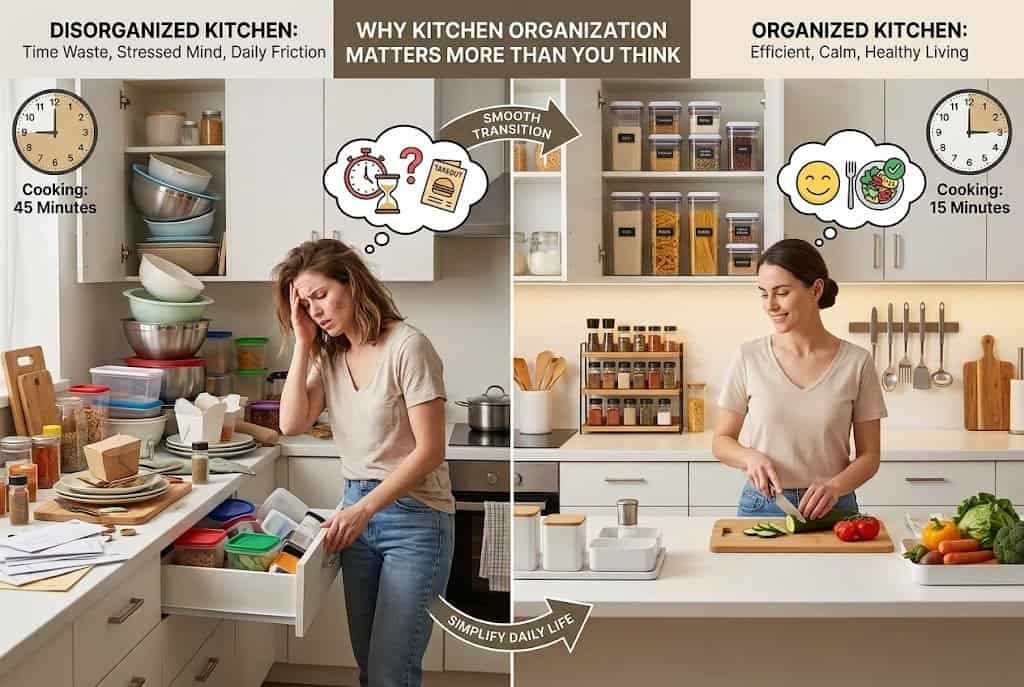
Why Kitchen Organization Matters More Than You Think
The kitchen is statistically the most-used room in nearly every home, which means a disorganized kitchen creates more daily friction than disorganization in any other space. Every time you cook a meal in a chaotic kitchen, you waste minutes searching for tools, ingredients, and storage containers. Multiply that across breakfast, lunch, dinner, snacks, and cleanup every single day, and the cumulative time loss adds up to hours per week — hours you could be spending on actually enjoying meals, family time, or rest instead.
Beyond the time cost, kitchen disorganization creates real mental load that most people don’t recognize until it’s gone. A cluttered countertop you see fifty times a day creates background stress your brain processes constantly. Knowing that opening any cabinet might trigger an avalanche of poorly-stacked containers makes you avoid cooking at home, which leads to more takeout, more spending, and less control over what you’re feeding yourself and your family. A truly organized kitchen removes all of this friction and quietly improves quality of life in ways that are hard to quantify but easy to feel.
The good news is that you don’t need a custom kitchen renovation or expensive built-ins to dramatically improve your kitchen organization. Most of the highest-impact solutions are simple, affordable, and can be implemented in a single weekend with items from the dollar store, IKEA, or Amazon. The key is matching the right organization system to the right problem rather than blindly buying organizers and hoping they help. These 20 kitchen organization hacks will give you specific solutions to specific common problems.
1. Use Vertical Dividers for Baking Sheets and Cutting Boards
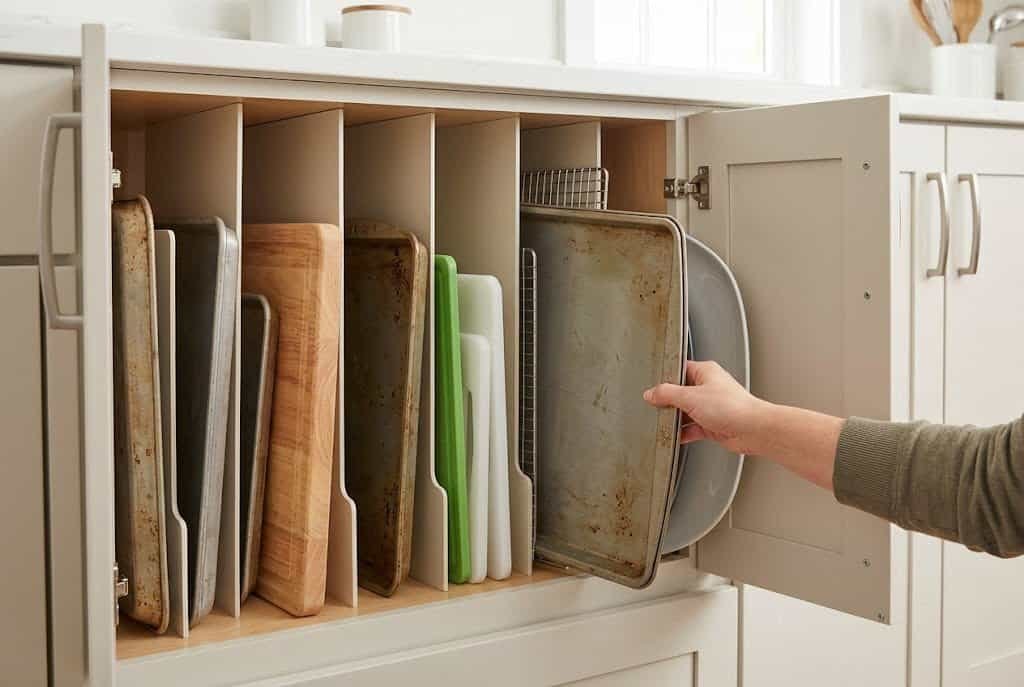
The cabinet where you store baking sheets, cutting boards, cooling racks, and serving platters is usually one of the most chaotic spaces in any kitchen. When you stack these flat items horizontally, you have to lift everything off the top to grab the one item you need on the bottom — guaranteed to either annoy you or trigger a kitchen avalanche on a regular basis. Vertical storage solves this problem completely and changes how you interact with these items.
Install adjustable vertical dividers in a tall cabinet or buy a freestanding rack designed specifically for baking sheets. The vertical orientation means every item is independently accessible — you grab exactly what you need without disturbing anything else. Most cabinet stores sell pre-cut dividers, but you can also create custom solutions using tension rods, wire shelf risers, or even DIY wooden dividers cut to fit your specific cabinet.
This single change makes a noticeable difference in your daily cooking flow. The mental shift from “I’ll dread getting that out” to “I’ll grab that quickly” actually changes which recipes you cook because you’re no longer subconsciously avoiding tools that are inconvenient to access. It’s the kind of small organizational win that quietly improves everything.
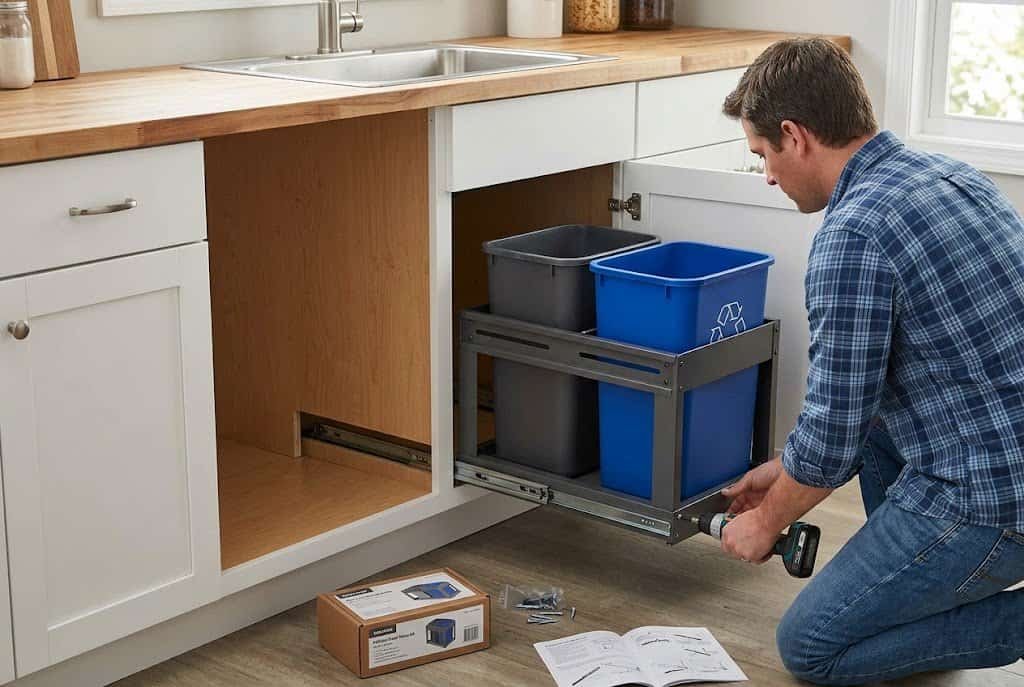
2. Install a Pull-Out Trash and Recycling System
The freestanding kitchen trash can that lives next to your cabinets takes up valuable floor space, looks unattractive, and forces you to walk around it constantly. Replacing it with a pull-out trash and recycling system inside a cabinet is one of the most life-changing kitchen organization upgrades you can make, even if you have to do it as a DIY project rather than a built-in.
Cabinet-mounted pull-out systems hold one to three bins inside a base cabinet, usually next to or under your sink. Pull-out kits are widely available at home improvement stores and install with basic tools. Choose a setup that includes separate compartments for trash, recycling, and possibly compost depending on your local recycling rules. The cabinet door stays closed during normal life, hiding the bins entirely and giving you back significant floor space.
Beyond the visual improvement, pull-out trash systems are also more hygienic because the bins are enclosed when not in use, reducing odors and pest issues. Many systems also feature soft-close mechanisms so the cabinet door doesn’t slam shut, and some include automatic lid-opening functions when you pull out the drawer. The investment quickly pays itself back in convenience and improved kitchen aesthetics.
3. Organize Your Junk Drawer with Custom Inserts
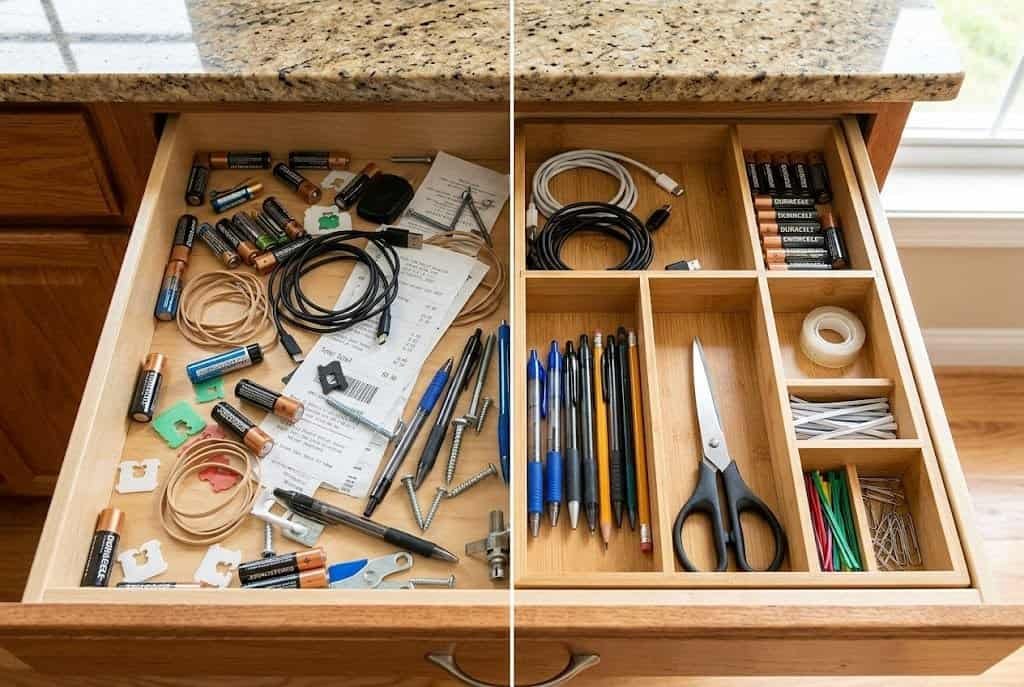
Every kitchen has at least one junk drawer, and most have several. The junk drawer is usually the dumping ground for batteries, twist ties, takeout menus, random hardware, expired coupons, mystery keys, and the kind of miscellaneous items that don’t have an obvious home elsewhere. While the existence of junk drawers is essentially universal, the chaos within them is optional.
Buy or build custom drawer inserts that create defined compartments for different categories. Adjustable bamboo drawer organizers expand to fit different drawer sizes and let you create as many compartments as you need. Inside each compartment, store related items together — batteries with batteries, pens with pens, scissors and tape with similar tools. The visual separation alone makes finding things faster.
The key to maintaining an organized junk drawer is being honest about what should actually live there versus what should be elsewhere. Takeout menus belong in a folder or pinned to the refrigerator. Important keys belong on a hook by the door. Old receipts belong shredded. Once you’ve removed everything that has a better home, what’s left should be minimal enough that even loose organization is manageable.
 📌 Save
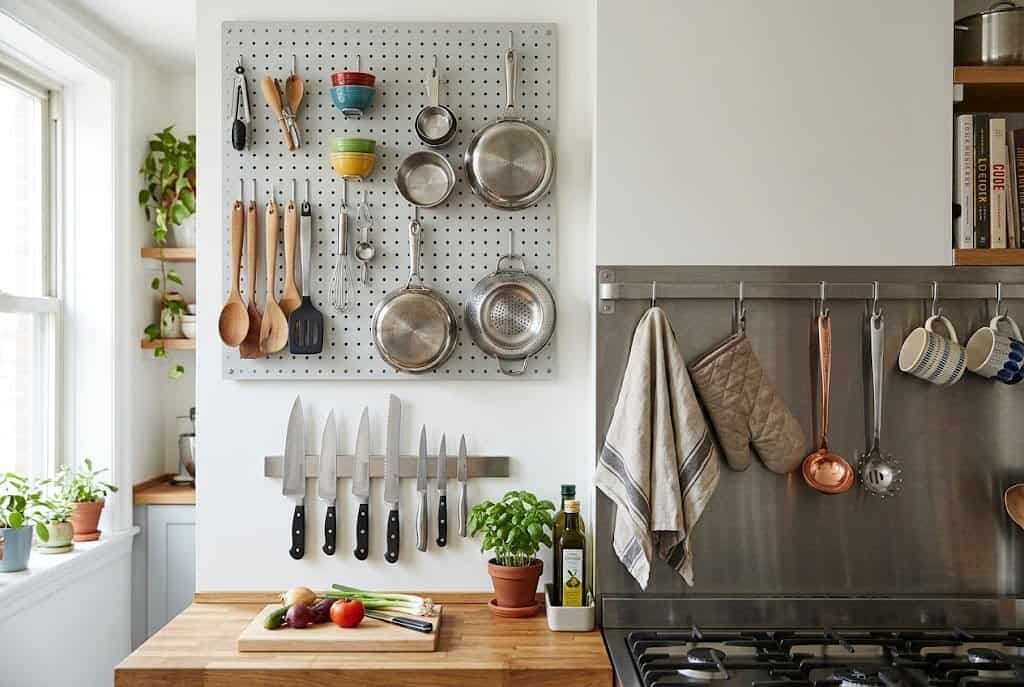
4. Maximize Vertical Wall Space with Magnetic Strips and Pegboards
The walls of your kitchen represent untapped storage real estate that most people completely ignore. Adding magnetic strips for knives, pegboards for utensils, and rail systems for hanging tools dramatically increases your usable storage without requiring any cabinet space at all. These solutions work especially well in small kitchens where every inch of cabinet space is already spoken for.
Magnetic knife strips replace traditional knife blocks that take up counter space and make it difficult to clean around them. Mounted on the wall above your prep area, they keep knives accessible, properly stored (which extends their sharpness), and visible so you grab the right one immediately. A pegboard mounted to a wall — painted to match your kitchen color or left natural for a farmhouse feel — holds utensils, measuring cups, mixing bowls, and pots in a way that’s both practical and visually interesting.
Custom rail systems with hooks let you hang ladles, spatulas, oven mitts, dish towels, and even mugs along a single horizontal rail. Position rails along backsplash areas, beside the stove, or over a kitchen island. This hanging storage actually decreases visual clutter compared to cluttered drawers because everything is intentionally displayed and accessible rather than crammed out of sight.
5. Use Tiered Shelf Risers in Cabinets
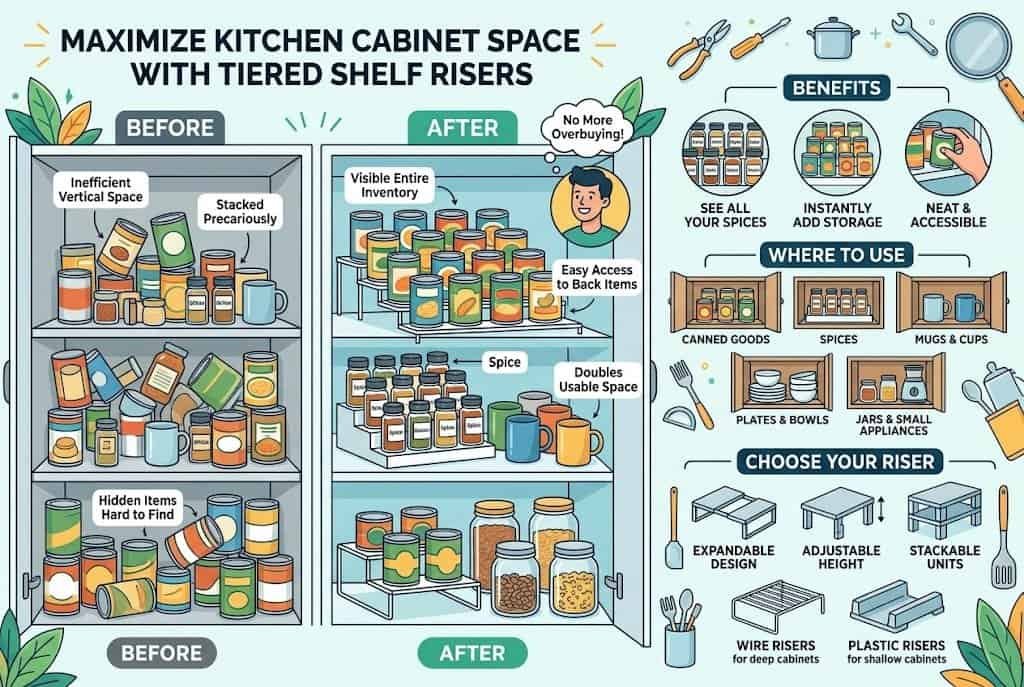
Most kitchen cabinets are inefficient because they have too much vertical space between shelves. Items get stacked precariously or piled on top of each other, making it impossible to see or access what’s underneath. Tiered shelf risers — simple wire or plastic stands that create stepped storage levels — instantly double or triple your usable cabinet space without adding any actual square footage.
Place tiered risers in cabinets storing canned goods, spices, jars, mugs, plates, and small appliances. The stepped design means items in the back are elevated and visible rather than hidden behind items in front. You can see your entire inventory at a glance, which prevents the “I bought another can of black beans because I forgot I had four already” syndrome that affects nearly every household.
Look for risers in expandable, adjustable, or stackable designs that accommodate different cabinet depths and heights. Wire risers work well in deep cabinets, while smaller plastic ones fit better in shallow cabinets or drawers. Spice cabinets specifically benefit enormously from tiered risers — you can finally see all your spices at once instead of digging through unlabeled jars in random rows.
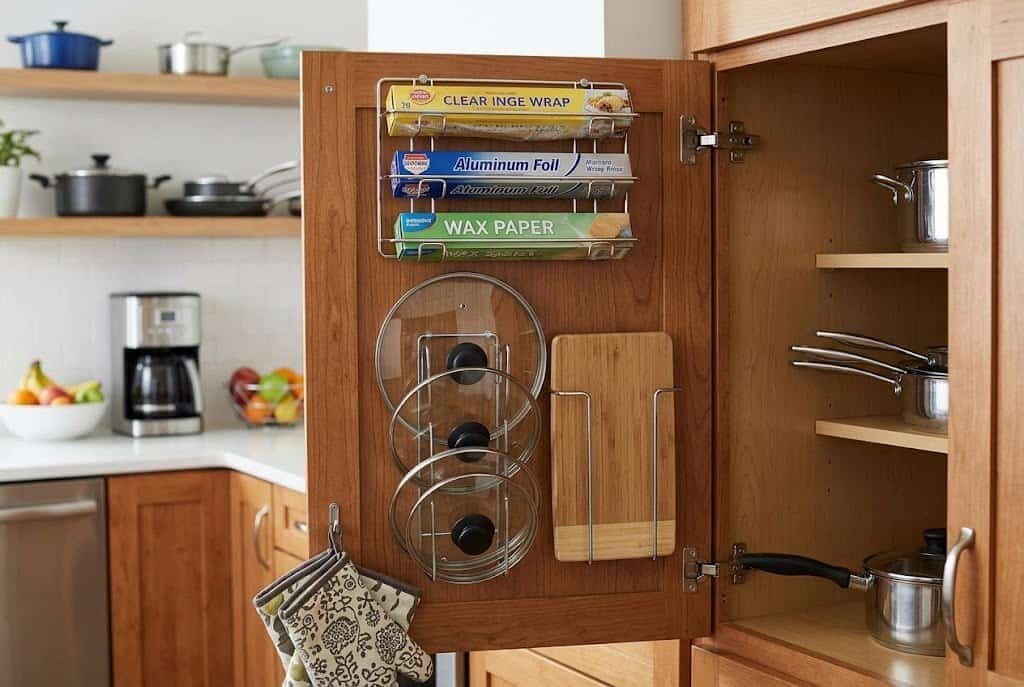
6. Install Cabinet Door Storage for Wraps and Lids
The inside of cabinet doors is one of the most underutilized storage zones in any kitchen. With simple over-the-door organizers or mounted racks, you can transform this typically wasted space into prime real estate for items that are otherwise difficult to store: plastic wrap and foil boxes, cutting boards, baking sheet lids, pot lids, and oven mitts.
A pot lid organizer mounted to the inside of a cabinet door solves the universal problem of mismatched, scattered lids that never seem to be where you need them. Wrap and foil holders mounted similarly keep these awkwardly-shaped boxes out of drawers where they take up disproportionate space. Cutting boards stored vertically against the door free up cabinet shelves for other items.
When installing door storage, use the inside of doors that are heavily used (under-sink cabinet doors, your main cookware cabinet) so you discover and use the new storage daily. Mounted hardware should be lightweight and securely attached — use hardware appropriate for the door material, and avoid putting heavy items on doors that swing wide. Used thoughtfully, cabinet door storage can add the equivalent of an entire extra small cabinet’s worth of usable space.
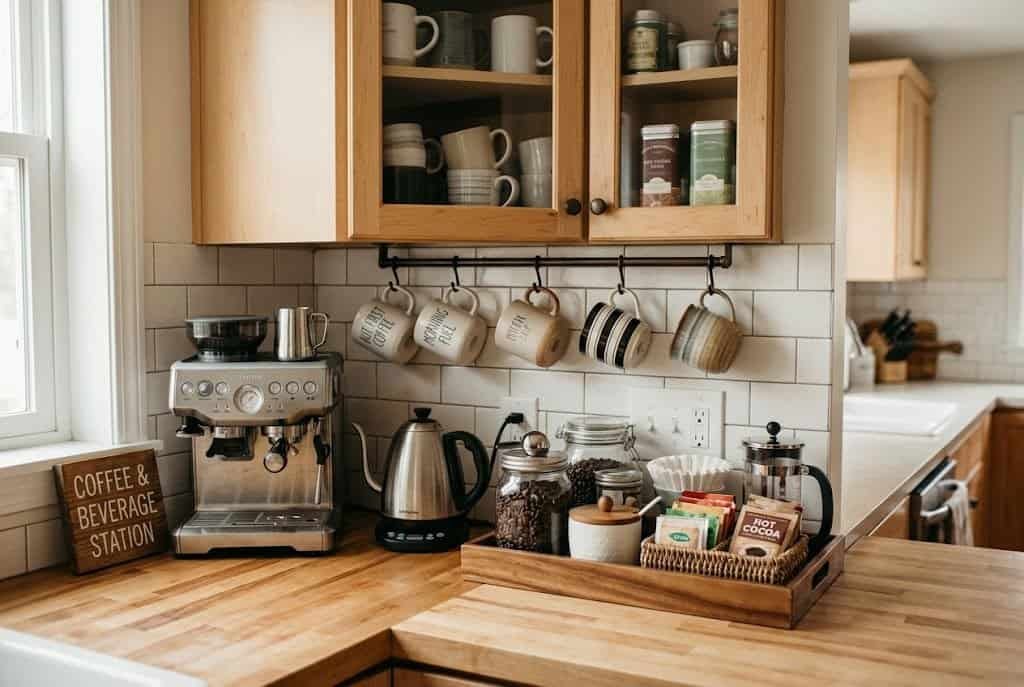
7. Create a Coffee or Beverage Station
Coffee makers, tea kettles, mugs, sugar, and assorted accessories tend to spread across kitchen countertops and cabinets in chaotic ways that make morning routines slower than they need to be. Creating a dedicated beverage station — even just a designated zone on a single counter or in one cabinet — consolidates everything into one efficient hub.
Choose a corner of countertop or a single cabinet where you can group your coffee maker, mugs, coffee beans, sugar, and any additional items like a French press or electric kettle. Add a small tray or basket to corral the visible items and make the zone feel intentional rather than cluttered. Mount mugs on hooks under upper cabinets to keep them accessible without taking up shelf space.
The beauty of a dedicated beverage station goes beyond aesthetics. Your morning routine becomes more efficient because everything you need is in one place. Guests can serve themselves without searching your kitchen. And the rest of your kitchen stays cleaner because the constant flow of coffee-making activity is contained in one defined zone rather than spreading across multiple surfaces.
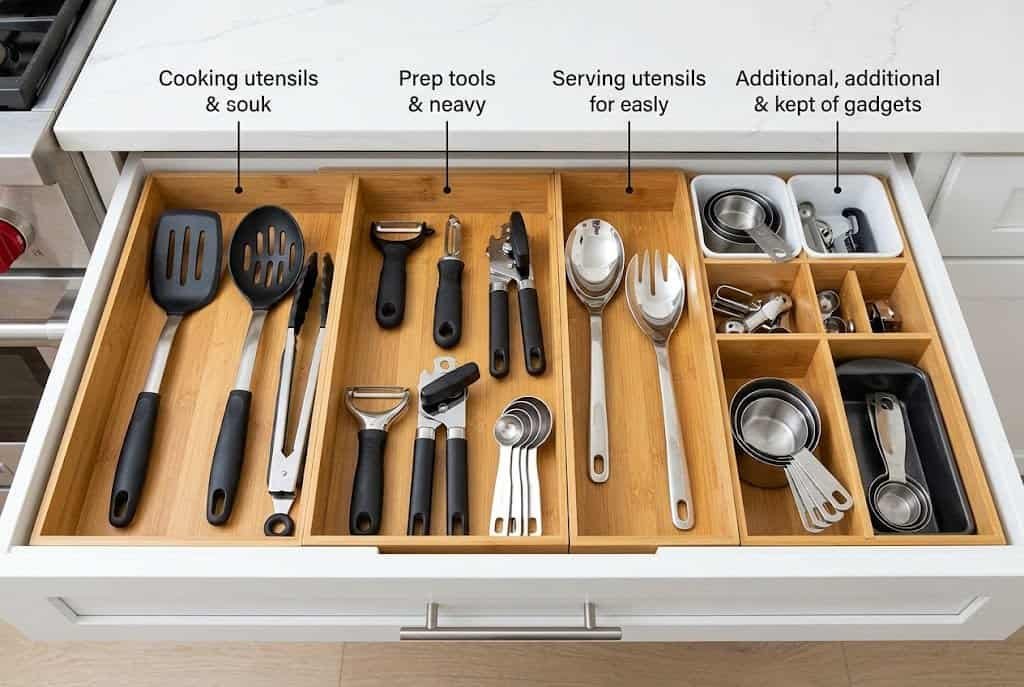
8. Use Drawer Dividers for Utensils and Tools
The standard plastic utensil tray with a few generic compartments is universally inadequate for the actual variety of utensils most people own. Custom drawer dividers — particularly the adjustable bamboo or wooden ones — let you create exactly the compartments you need for your specific utensil collection, dramatically improving how quickly you find what you need while cooking.
Rather than dumping all utensils into a single drawer or tray, create specialized zones. Group cooking utensils (spatulas, slotted spoons, tongs) in one section. Keep prep tools (peelers, can openers, measuring spoons) in another. Reserve a third area for serving utensils used at the table. The visual organization speeds up cooking because muscle memory takes over and you reach for the right area without thinking.
For drawers holding gadgets and small tools, use small bins or dividers to create defined homes for each category — measuring cups stack together, mixing tools have their own compartment, baking specialty items live separately from everyday tools. The principle of “everything has a home” applies powerfully in drawers: when each item has a specific place, returning it after use becomes automatic rather than something you have to think about.
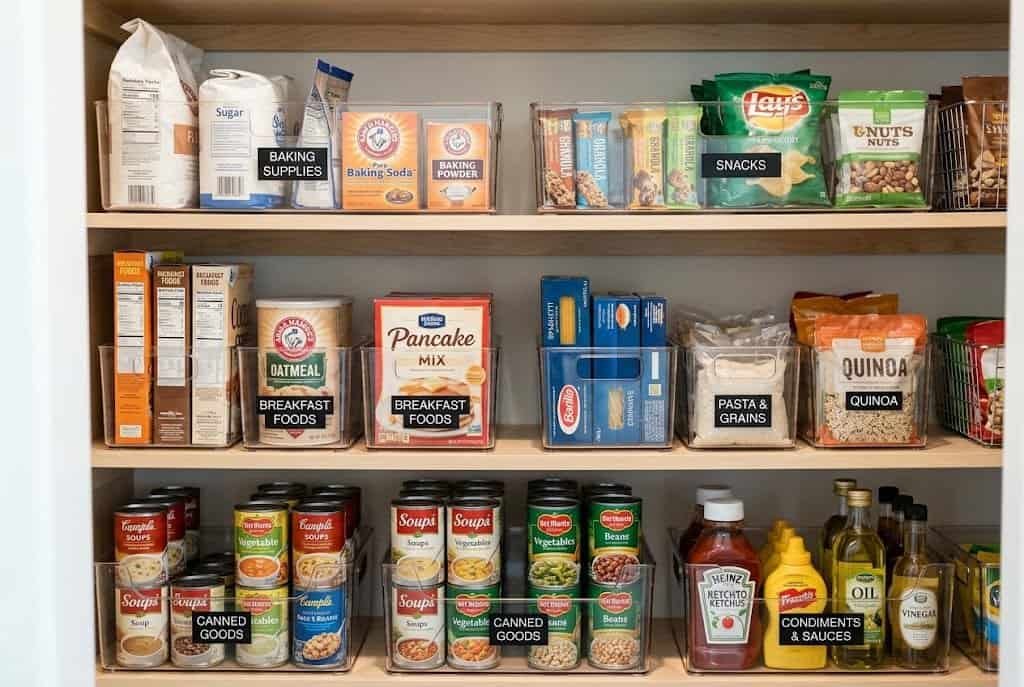
9. Group Pantry Items by Category in Clear Bins
The pantry is where most kitchen organization efforts succeed or fail dramatically. A poorly organized pantry creates ongoing frustration, food waste from forgotten items, and the maddening experience of buying things you already have because you couldn’t find them. The solution is grouping items by category in clear, labeled bins or baskets that you can see at a glance.
Buy clear plastic or wire bins in coordinating sizes and group related items together: baking supplies, snacks, breakfast foods, pasta and grains, canned goods, condiments, and so on. Within each bin, items can be loose or further organized as needed. The clear material means you can see the contents without removing the bin, and you can pull out the entire bin when cooking to access everything in that category at once.
Label each bin clearly, even if it seems obvious — labels train family members to return items to the correct location. Use a label maker for a polished look, or chalkboard labels for a farmhouse feel. The labeling also helps you quickly notice when a category is running low because empty space in a labeled bin is more visible than empty space in a generic mess.
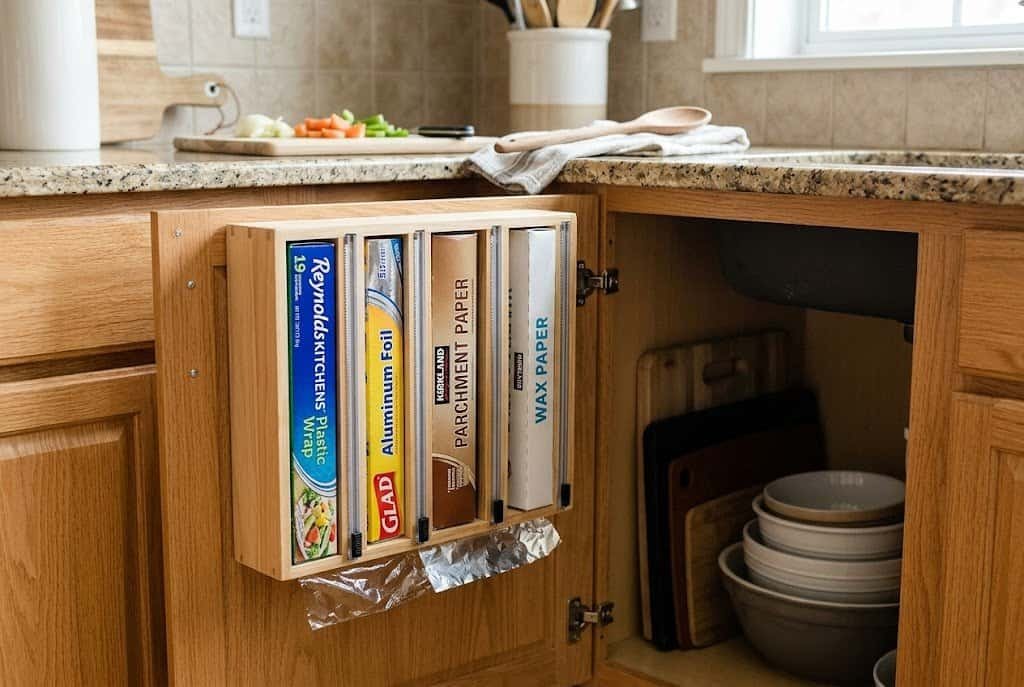
10. Roll Your Plastic Wrap and Foil Boxes Into a Single Holder
Plastic wrap, aluminum foil, parchment paper, and wax paper boxes are awkwardly long and don’t fit neatly anywhere. They’re either falling over in drawers, taking up shelf space they don’t deserve, or occupying valuable cabinet real estate. A single dedicated wrap and foil holder consolidates all of these into one efficient space and makes them easier to use.
Wall-mounted or cabinet-mounted wrap holders typically include slots for three to four boxes side by side, often with built-in tear edges that make using them faster than using the boxes directly. Mount the holder inside a cabinet door, on the side of a kitchen island, or on a wall near your prep area. The boxes become permanently accessible without taking up shelf space.
For an even more streamlined system, transfer wrap, foil, and parchment to refillable holders that look more attractive than the original boxes. Some homeowners go even further and store these items in matching wooden or metal dispensers for an aesthetic that approaches commercial kitchen efficiency. The result is faster, neater food storage during meal prep.
11. Use Lazy Susans in Corner Cabinets
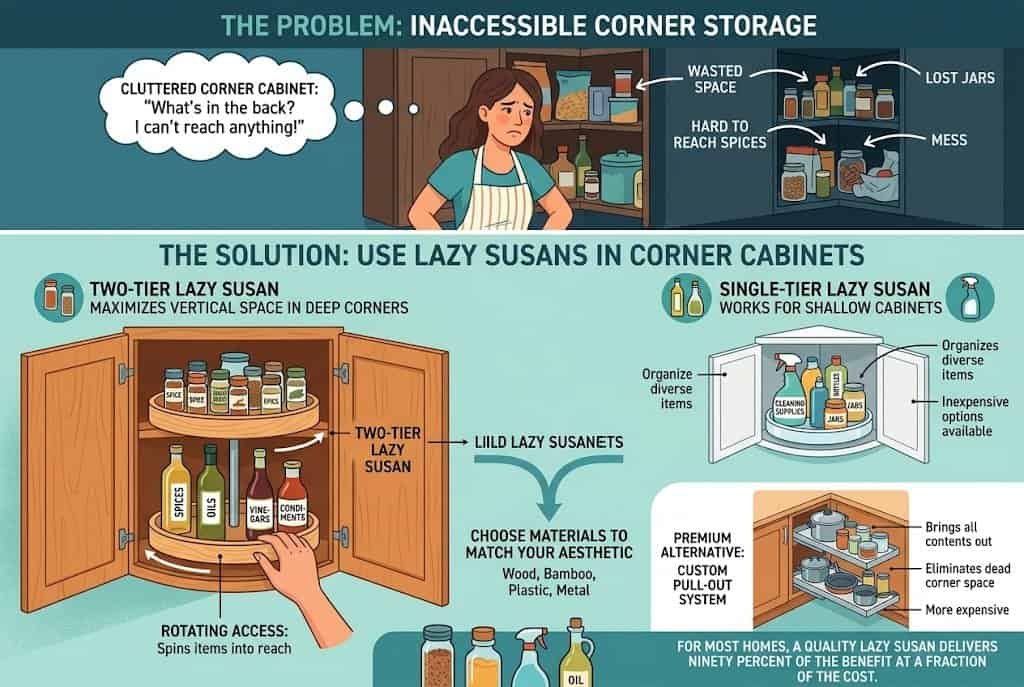
Corner cabinets are notoriously difficult to use because items get pushed deep into the corner and become inaccessible without removing everything in front of them. The lazy Susan — a rotating tray that lets you spin items into reach — has been around forever for exactly this reason, and it remains one of the most effective solutions for corner storage problems.
Single-tier lazy Susans work for shallow cabinets, while two-tier versions maximize vertical space in deeper corners. Use them for spices, oils and vinegars, cleaning supplies, condiments, or any items where rotating access matters. Materials range from inexpensive plastic to beautiful wood and bamboo, so you can choose options that match your kitchen’s aesthetic if the lazy Susan will be visible.
For even better corner cabinet utilization, install a custom corner pull-out system that brings all the contents out of the corner when you open the cabinet. These systems are more expensive but eliminate the dead corner space entirely. For most homes, though, a quality lazy Susan delivers ninety percent of the benefit at a fraction of the cost.
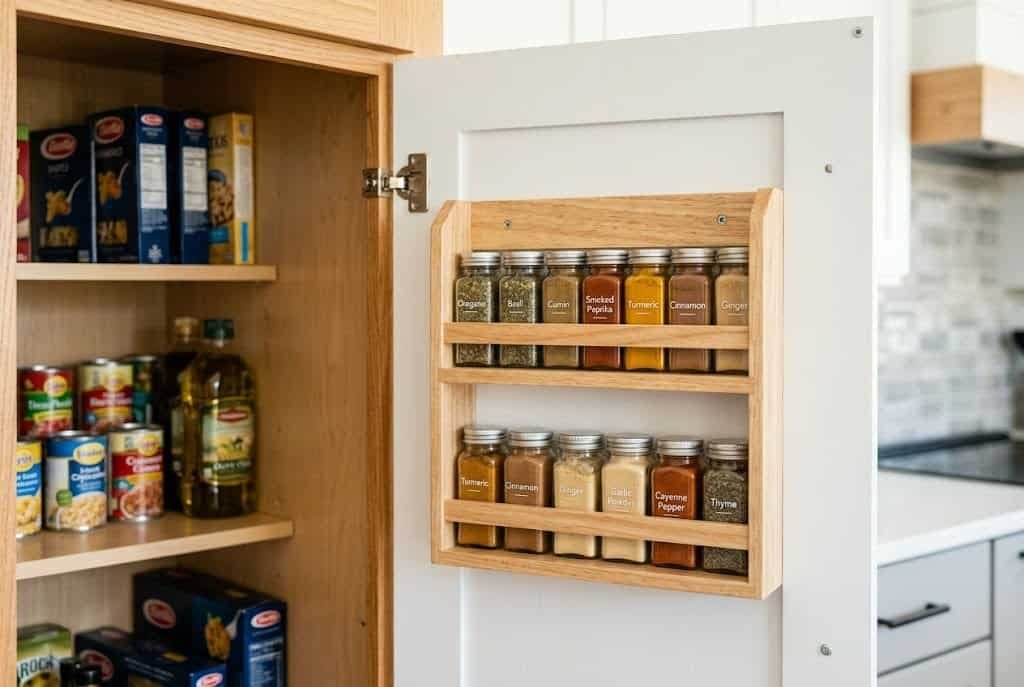
12. Mount Spice Racks on the Inside of Pantry Doors
Spices are notoriously difficult to organize. Most spice cabinets devolve into chaotic piles where bottles in the back are forgotten until they expire. Mounting spice racks on the inside of pantry or cabinet doors solves this problem brilliantly — every spice is visible, accessible, and rotated regularly because you can see them every time you open the door.
Door-mounted spice racks come in many forms: simple wire racks, magnetic strips with metal-lidded jars, tiered plastic systems, or custom wood racks. Choose based on the door size and your spice collection. For bigger collections, you might use the door storage for everyday spices while keeping bulk spices and rarely-used ingredients in cabinet shelves.
The visibility factor is genuinely transformative. When you can see your entire spice collection at once, you actually use more variety in your cooking because forgotten spices are no longer buried out of sight. You also notice quickly when something is running low and can replace it before you’re caught mid-recipe with an empty jar.
13. Create a Drop Zone Near Your Kitchen Entrance
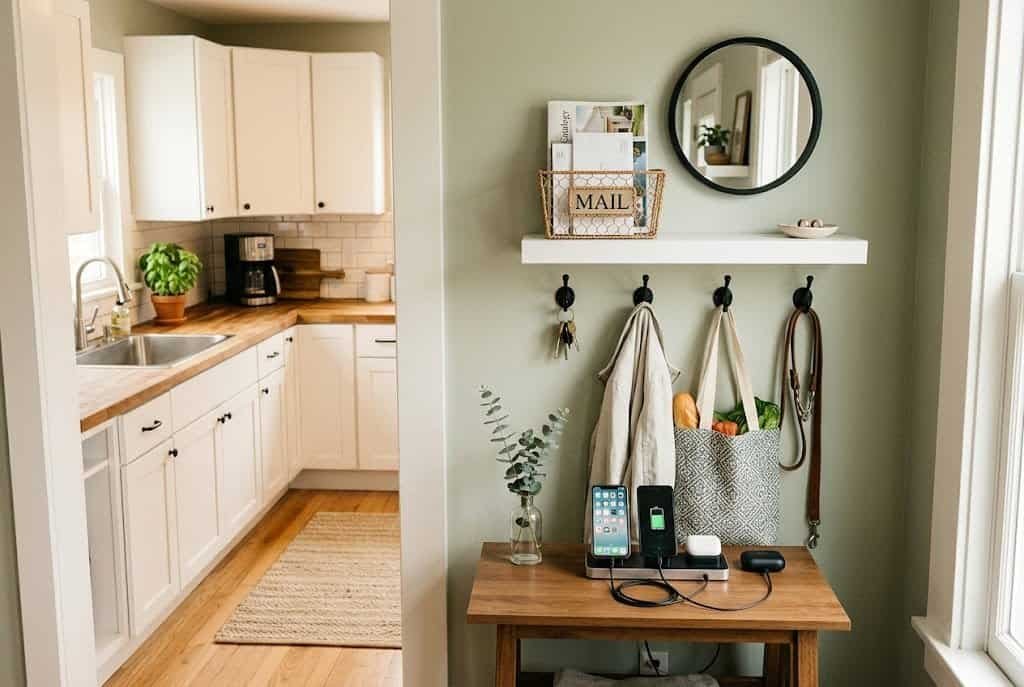
The kitchen entrance is where mail, keys, bags, and miscellaneous items tend to accumulate, even though none of these things are kitchen items. A dedicated drop zone — a small designated area for handling these incoming items — keeps them from spreading across counters and creates a smooth transition between coming home and being home.
Install a small floating shelf, wall hooks, a basket, or a simple console table near the kitchen door. This zone becomes the first stop when entering: keys go on hooks, mail goes in a small basket or organizer, bags go on a hook or shelf. The boundary keeps these non-kitchen items contained rather than gradually colonizing your countertops.
For families, consider adding a charging station to the drop zone where phones can plug in and charge. This single feature eliminates the kitchen counter charging chaos that plagues most modern households. Add a small mirror, a ring dish for jewelry, and a hook for the dog’s leash, and you’ve created a true entry zone that serves your real life.
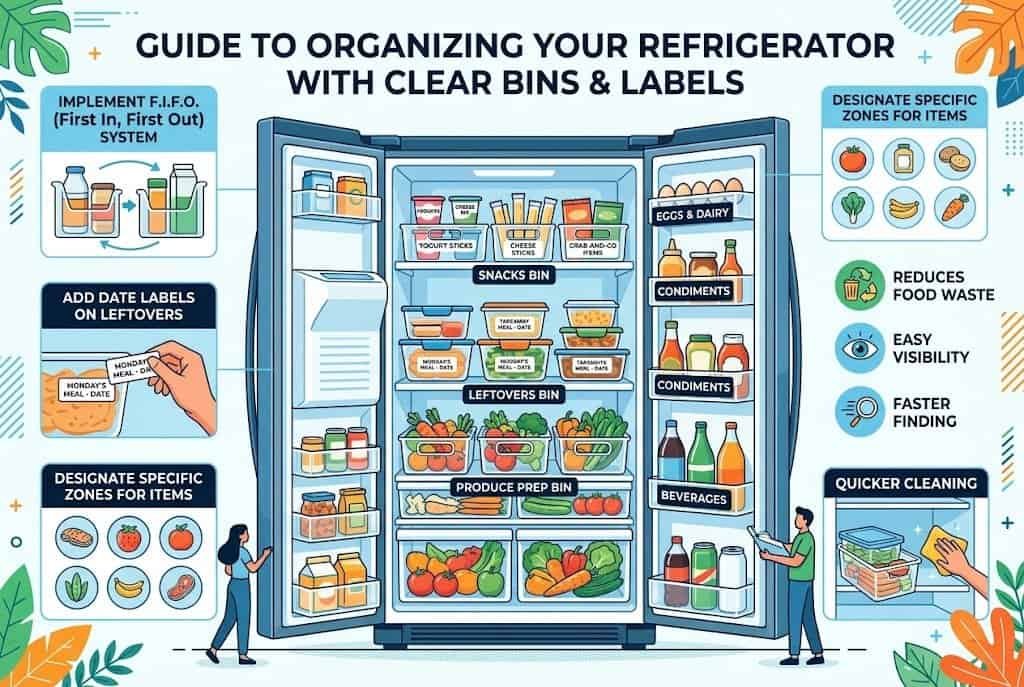
14. Organize the Refrigerator with Clear Bins and Labels
A disorganized refrigerator is responsible for an astonishing amount of food waste — items get pushed to the back, forgotten, and discovered weeks later spoiled. The solution is approaching the refrigerator with the same intentionality as the pantry: clear bins for categories, designated zones for specific item types, and visibility that prevents anything from disappearing into the void.
Use clear plastic bins on each shelf to group items: a “snacks” bin holds yogurts and grab-and-go items, a “leftovers” bin keeps takeaway containers visible, a “produce prep” bin holds washed and ready-to-eat fruits and vegetables. The bins make refrigerator cleaning faster (pull them out, wipe shelves, replace) and prevent items from getting lost behind taller items.
Implement a “first in, first out” rotation system where new items go behind older ones, and consider adding date labels on leftovers so you remember when they were made. Designate specific zones for specific items — eggs always live here, dairy lives there — so family members can find things easily and return them to the right spots.
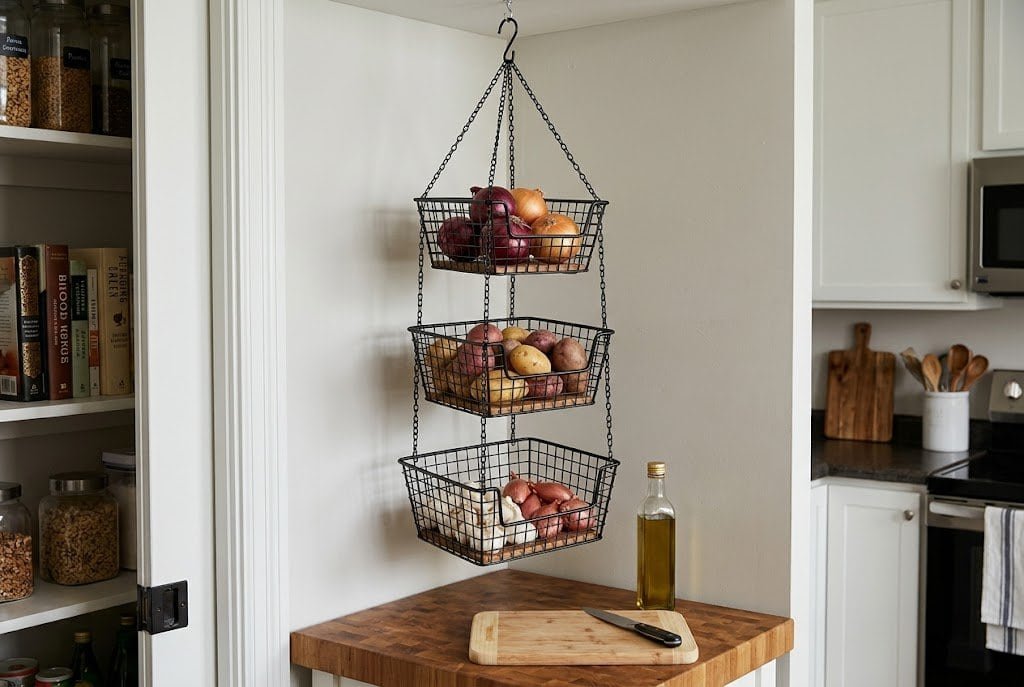
15. Use Hanging Baskets for Produce That Doesn’t Need Refrigeration
Onions, potatoes, garlic, and other produce that shouldn’t be refrigerated tend to clutter countertops or get shoved into pantry corners where they sprout, soften, and eventually spoil. Hanging produce baskets — typically a tiered set hanging from the ceiling or mounted on a wall — give these items dedicated, well-ventilated storage that extends their freshness.
A three-tier hanging basket can store onions on top, potatoes in the middle, and garlic on the bottom (or whatever organization makes sense for your cooking habits). The air circulation around hanging produce significantly extends its shelf life compared to storage in closed bins or sealed bags. The visible storage also reminds you to actually use these ingredients before they go bad.
Position the basket in a cool, dry area away from direct sunlight and heat sources like the stove. The wall above a small counter, the corner of a pantry, or a section of unused kitchen wall all work well. The vertical orientation reclaims kitchen space while solving the produce storage problem in a way that traditional containers can’t match.
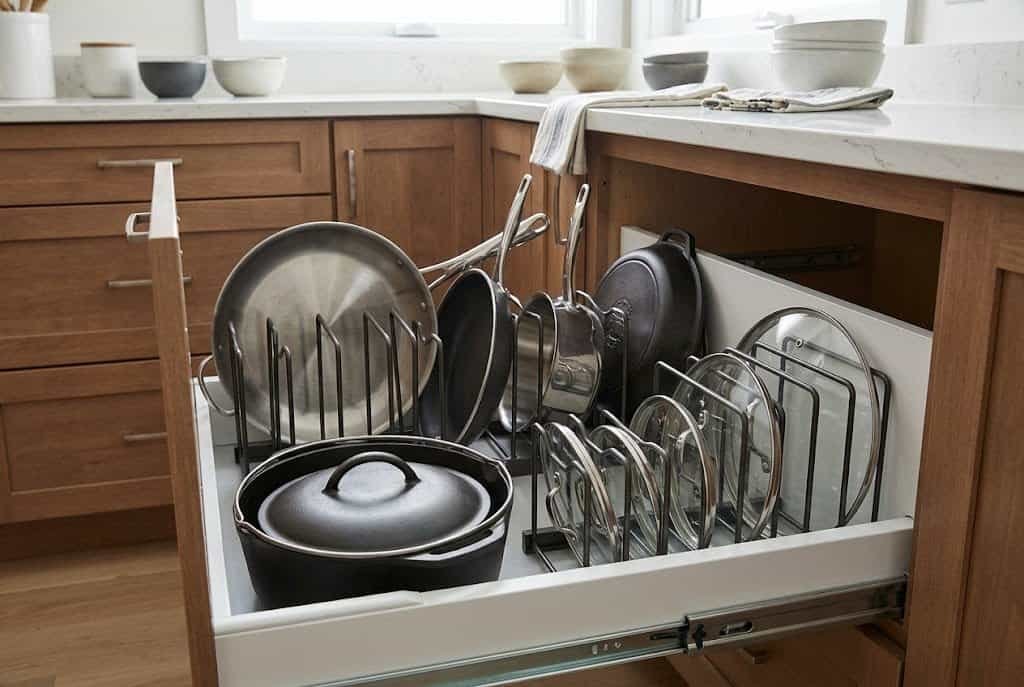
16. Stack Pots and Pans with Vertical Organizers
Stacking pots and pans inside each other is the universal default storage method, but it’s also the worst. Every time you need a specific pot, you have to lift off the pots stacked on top, often crashing them around in the process. Vertical pot organizers — wire racks that hold pots and lids upright — eliminate the stacking problem entirely.
Install a vertical organizer in a deep cabinet or drawer designed for cookware. Each pot has its own slot, and lids store separately in dedicated lid holders or stand up next to their pots. Grabbing the right pot becomes a single motion rather than a multi-step rearrangement.
For homes with significant cookware collections, consider hanging pot racks over kitchen islands or along walls. Hanging storage keeps pots accessible, frees up cabinet space, and adds visual interest to your kitchen. Choose hanging racks based on your kitchen style — industrial pipe racks for modern spaces, rustic wood pot rails for farmhouse kitchens, or clean stainless steel for contemporary aesthetics.
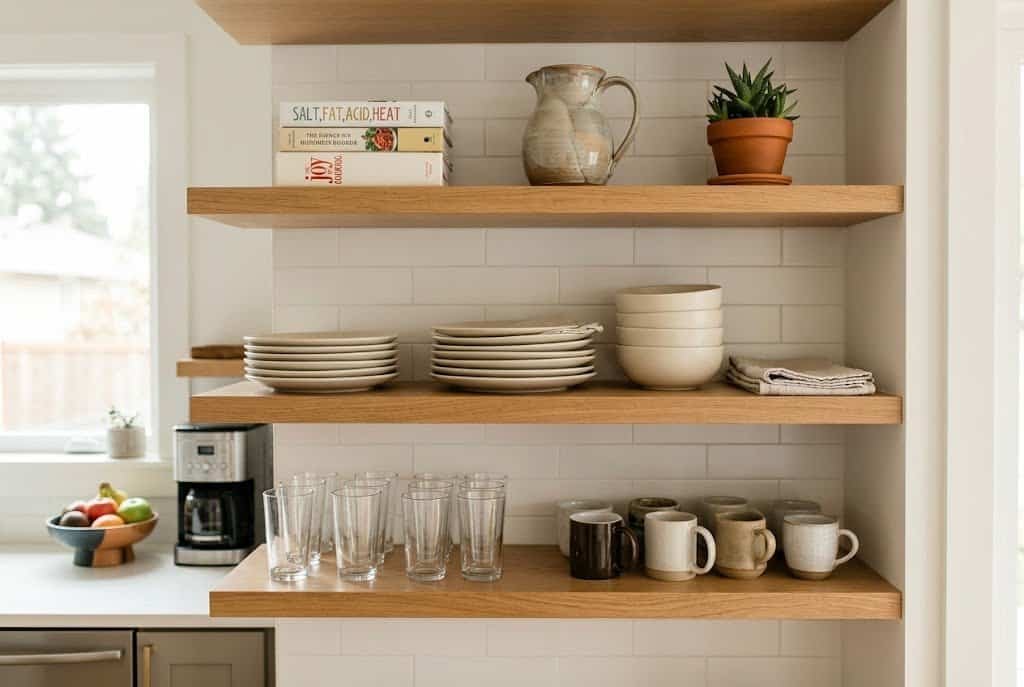
17. Use Open Shelving for Frequently Used Items
Open shelving is controversial — some people love it, others find it impossible to maintain — but used strategically, it solves real organization problems. The key is putting only items you use daily on open shelves and keeping rarely-used items in closed cabinets where they can’t accumulate dust.
Reserve open shelves for everyday plates and bowls, drinking glasses, mugs, and a few attractive serving pieces. The visibility means these items are always accessible (no opening cabinets) and creates natural pressure to keep them organized because they’re always on display. Rotate items seasonally if you have collections of different colors or styles.
For open shelving to look intentional rather than cluttered, follow simple styling principles: stack matching items together, vary heights for visual interest, and leave breathing room between groupings. A few decorative items mixed in (a small plant, a beautiful pitcher, a stack of cookbooks) prevents the shelves from looking purely utilitarian. The combination of function and aesthetics is what makes open shelving work.
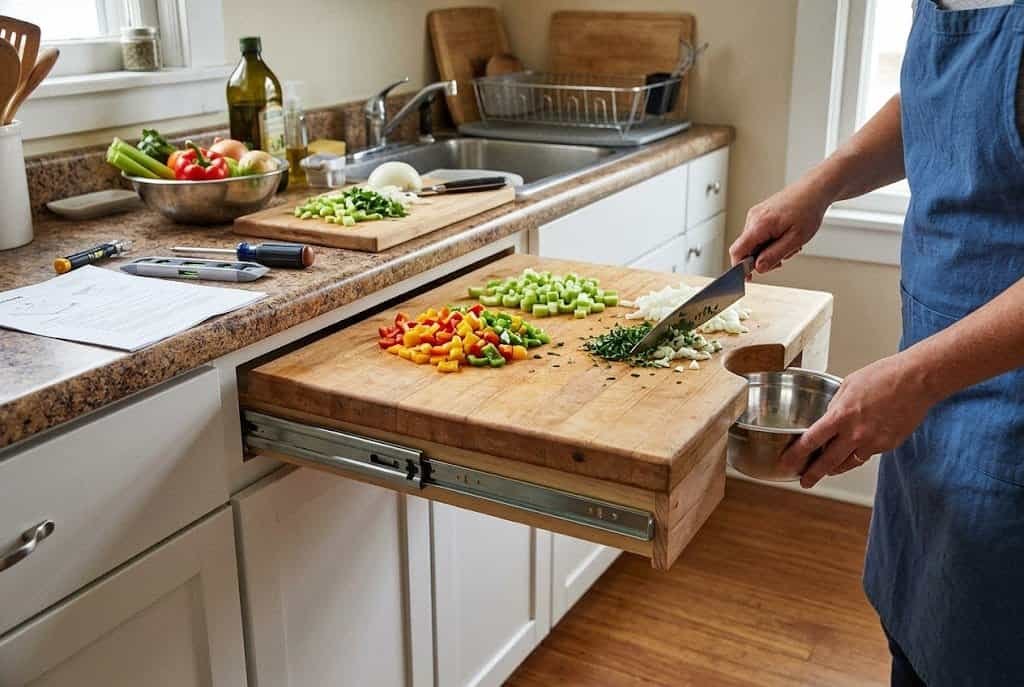
18. Install a Pull-Out Cutting Board
Pull-out cutting boards are a built-in feature in some custom kitchens, but you can add them retroactively to almost any cabinet. A drawer that pulls out to reveal a built-in cutting surface gives you instant prep space without requiring counter clearance or a separate cutting board to wash and store.
Pull-out boards work especially well in small kitchens where counter space is precious. They effectively double your prep area when needed but disappear completely when not in use. Many designs include a hole that lets you sweep chopped ingredients directly into a bowl below or into a trash receptacle.
For DIY installation, you can buy pull-out cutting board kits that fit standard drawer cabinets. Some homeowners get more creative, using a flat drawer face as the cutting surface itself, then washing it as needed. Whatever approach you choose, the convenience of having a dedicated prep zone you don’t have to set up and put away every time genuinely improves cooking workflow.
19. Use a Tension Rod Under the Sink for Spray Bottles
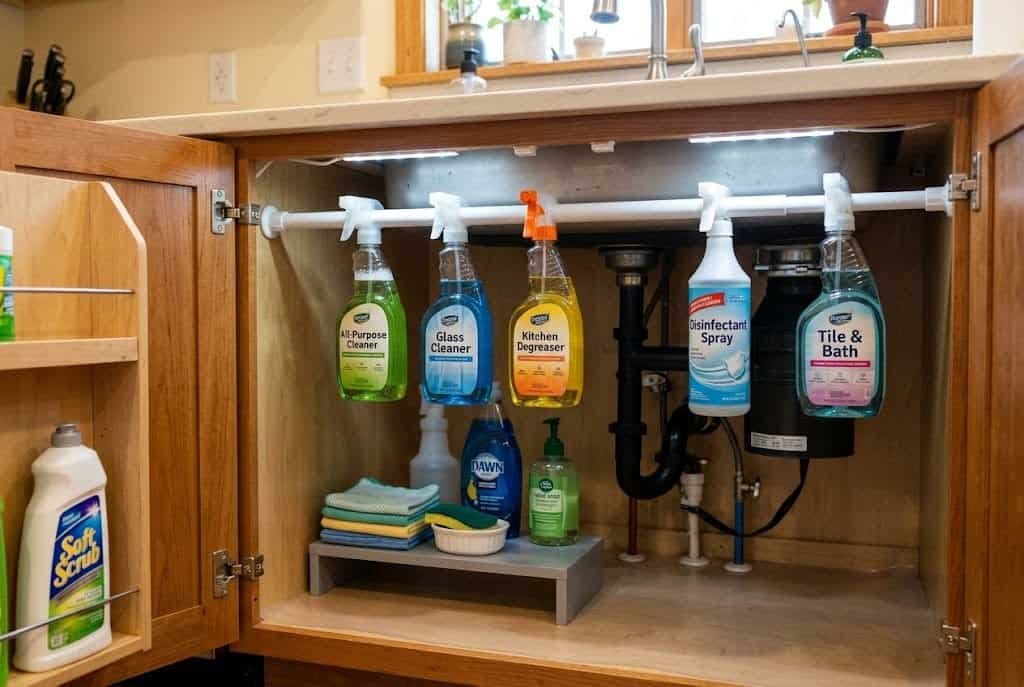
The under-sink cabinet is universally one of the most chaotic spaces in any kitchen, partly because of pipes that interfere with shelving and partly because cleaning supplies tend to multiply faster than you can organize them. A simple tension rod installed near the top of the cabinet creates an instant hanging system that solves the cleaning supply chaos elegantly.
Hang spray bottles by their trigger handles from the tension rod. The bottles dangle freely, taking up vertical space that’s otherwise wasted, while leaving the cabinet floor clear for other items like sponges, cleaning cloths, and additional supplies. You can fit far more spray bottles on a tension rod than you ever could standing on the cabinet floor.
This is one of those organization hacks that costs almost nothing — a single tension rod from the dollar store — but solves a problem that plagues nearly every household. The transformation in under-sink usability is dramatic and immediate, and it’s a great gateway hack for people just beginning to think about kitchen organization seriously.
20. Create a Kitchen Command Center
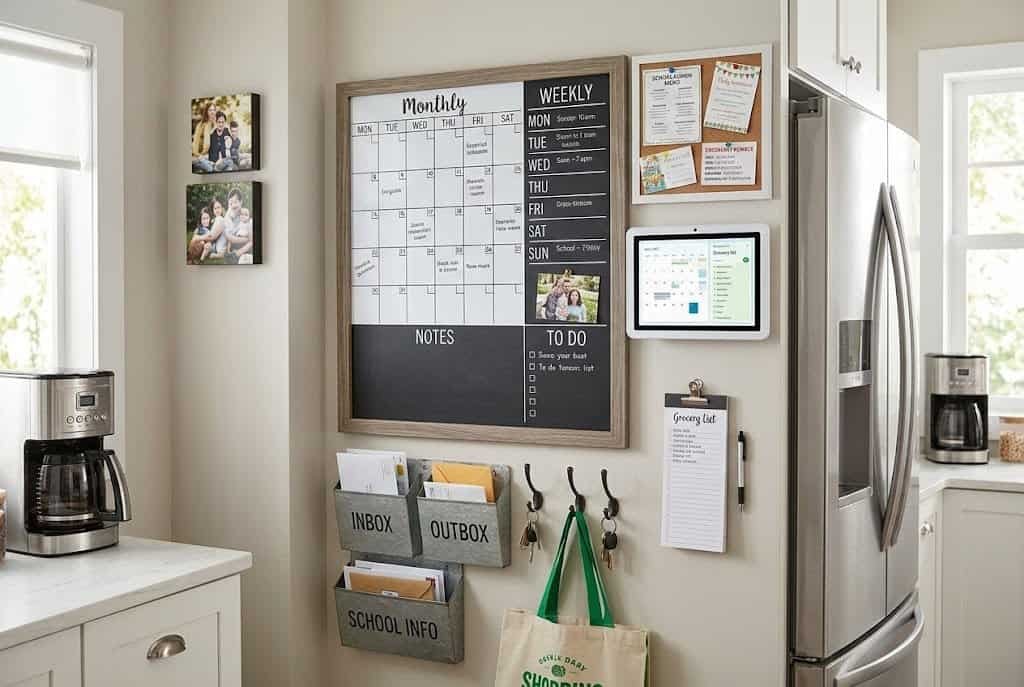
Beyond physical storage, kitchens need a command center for the information that runs household life: schedules, shopping lists, important phone numbers, school information, and the constant flow of paperwork that comes through every household. A dedicated command center gives this information a home and prevents it from cluttering counters.
Create a command center on a wall, the side of a refrigerator, or a small section of pantry door. Include a calendar (paper or digital), a place for grocery lists, a small bulletin board for important documents, and hooks or pockets for keys and incoming mail. Position it where the family naturally passes by daily so the system actually gets used.
A digital command center using a tablet or smart display can be even more efficient, integrating shared family calendars, grocery list apps, and reminder systems. Whatever system you choose, the principle is the same: information that previously cluttered your kitchen now has a designated home where everyone can find it. The mental clarity that comes from having household information organized rivals the relief of physical organization.
Maintaining Your Newly Organized Kitchen
Getting organized is one challenge — staying organized is the harder ongoing project. The most beautifully organized kitchen will return to chaos within months without small daily and weekly habits that maintain the systems you’ve created. The good news is that maintenance is much easier than initial organization, especially when each item has a defined home.
Build small daily routines: a five-minute kitchen reset before bed where everything goes back to its designated home, a weekly review of pantry and refrigerator contents to catch expiring items before they’re wasted, a monthly drawer or cabinet check to spot creeping disorganization before it becomes overwhelming. These small habits prevent the slow drift back to chaos that affects most kitchens.
When new items come into the kitchen — a new gadget, additional cookware, holiday baking supplies — take a moment to ask whether they have an existing home or whether something needs to leave to make room. The principle of “one in, one out” prevents the gradual accumulation of stuff that overwhelms even well-organized spaces. Your future self will thank your current self for maintaining the systems consistently rather than starting over every six months.
Loved these ideas? Save this pin to your “Kitchen Decor & Organization” board and share it with a friend who needs to tackle their kitchen too!
Read More: 20 Trending Paint Colors for Summer 2026: The Ultimate Color Palette Guide