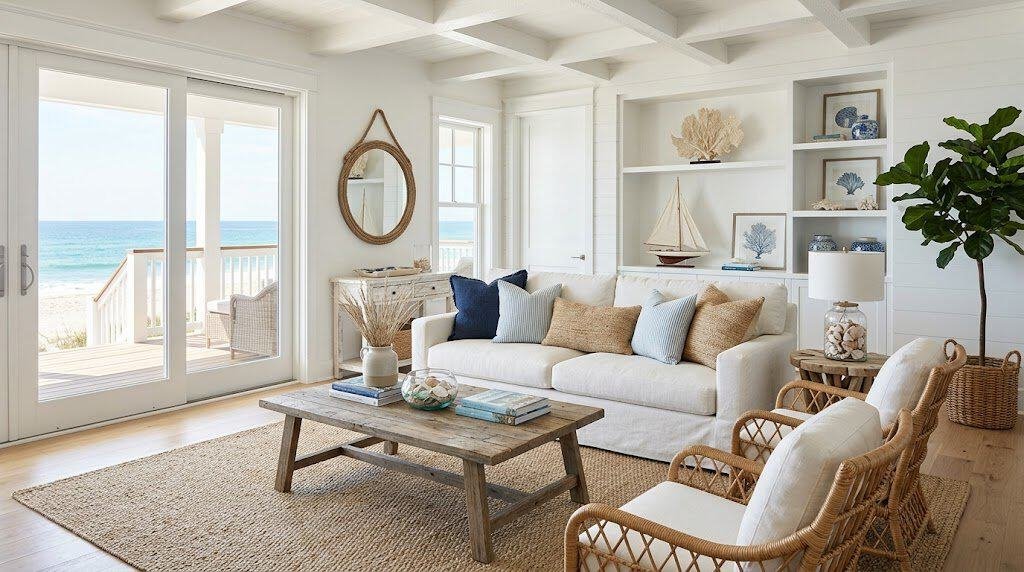
There is a particular kind of peace that settles over you in a room that feels like the coast. The light comes in soft and wide. The colors remind you of shallow water and sea glass. The textures are natural — linen, rattan, driftwood, rope. The whole space seems to exhale, and somehow, without quite knowing why, you exhale too.I’ve been chasing that feeling in my own home for years. My husband and I don’t live anywhere near the ocean — we’re firmly landlocked, surrounded by cornfields and the occasional small lake — but our living room has made more than one first-time visitor stop in the doorway and say, “This feels like a beach house.” That’s the highest compliment I know how to receive about a room.What I’ve learned after years of trial and error, thrift store finds, failed Pinterest recreations, and one very memorable weekend repainting our entire accent wall: coastal style is less about collecting beach-themed objects and more about understanding how the coast actually feels. It’s about light, texture, color, and the feeling of open space. Get those four things right, and you don’t need a single piece of driftwood to make a room feel like the sea.This guide covers 18 of the most effective coastal living room ideas I’ve found, used, or deeply studied — all with enough detail to actually implement them, and all designed for the kind of results that stop people in the doorway.
1. Build Your Color Palette Around the Shore, Not a Paint Chip
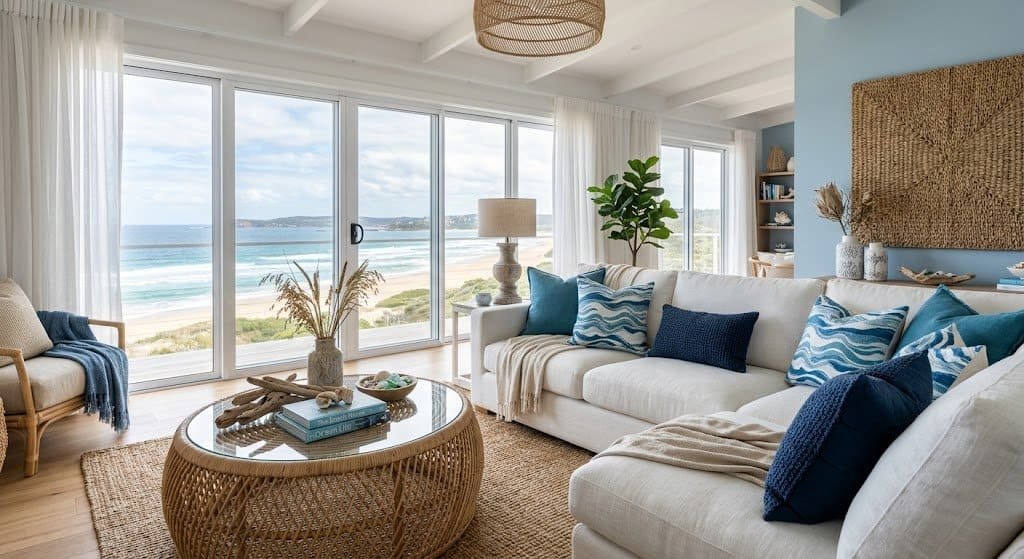
The single most important decision in a coastal living room is color, and the single most common mistake is choosing colors that look “beachy” on a paint chip without understanding how they’ll behave in an actual room. Coastal color is not just blue and white. The shore is a far more complex place than that.Think about what the coast actually looks like at different times of day: the sandy beige of dry dunes, the warm ivory of sun-bleached wood, the soft grey-green of sea grass, the particular blue-grey of overcast coastal skies, the chalky white of sea foam, the deep navy of deep water, the pale sage of salt marsh grass. These are your reference points — not the saturated tropical turquoise of a cruise ship advertisement.The most versatile coastal color palette for a living room uses a foundation of warm whites and soft sand tones on walls and large furniture pieces, introduces muted blues and greens in a secondary layer through pillows, throws, and small upholstered pieces, and adds depth with natural browns — driftwood, jute, walnut — as accent elements. This combination reads as coastal in every light condition, every season, and every style of room, from a small urban apartment to a sprawling farmhouse.Specific paint colors worth knowing: Benjamin Moore’s “White Dove” and “Simply White” for walls that feel bright but not stark. Sherwin-Williams “Sea Salt” for a muted, sophisticated coastal green that works in almost any room. Benjamin Moore “Hale Navy” for a deep anchor color on a single accent wall or built-in. Farrow and Ball “Mizzle” for a nuanced grey-green that evokes sea grass beautifully. These are not the only options, but they’re trusted starting points that thousands of designers and homeowners have used successfully.
2. Choose Linen and Slipcover Sofas Over Rigid Upholstery
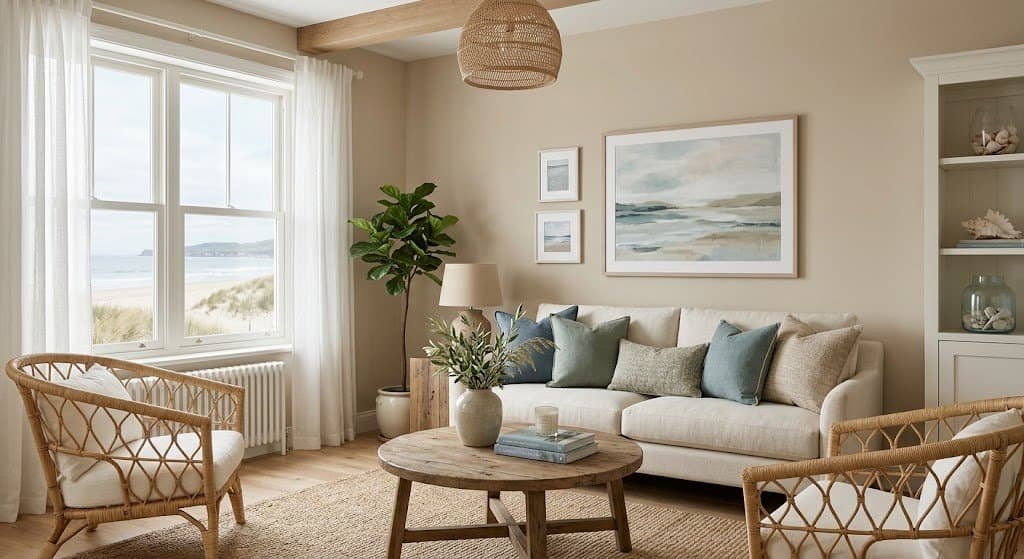
The sofa is the center of gravity in most living rooms, and in a coastal living room, the choice of sofa fabric makes an enormous difference in how the entire room feels. Tight, structured upholstery in synthetic fabric — the kind that holds its shape rigidly and repels every bit of dust — feels corporate and formal. It fights against the relaxed, natural, slightly-rumpled-in-the-best-way aesthetic that coastal style is built on.Linen and linen-blend sofas are the gold standard for coastal living rooms. Linen wrinkles slightly with use, which sounds like a flaw but is actually an asset: that gentle lived-in texture signals relaxation in the same way that a linen shirt worn at the beach does. It catches light in a soft, diffused way that synthetic upholstery simply cannot replicate. Natural linen comes in colors that are inherently coastal — warm oatmeal, pale grey, soft blue, warm white — and ages beautifully over years of use.Slipcover sofas are an underused and underappreciated option that work exceptionally well in coastal rooms. A slipcover sofa can be removed, washed, changed with the seasons, and replaced entirely without buying a new sofa frame. For a living room that doubles as a family space where sand and sunscreen and spilled drinks are a real possibility — or for anyone who wants the flexibility to evolve the room’s look over time — slipcovers offer a practicality that traditional upholstery cannot match.If you’re working with an existing sofa that isn’t linen or coastal in any way, a large linen throw draped casually over the back and arm can change the feeling of the piece significantly without costing more than $40–60. It’s not a permanent solution, but it’s a remarkably effective one while you’re working toward the larger room transformation.
3. Layer Natural Textures to Replicate the Sensory Experience of the Beach
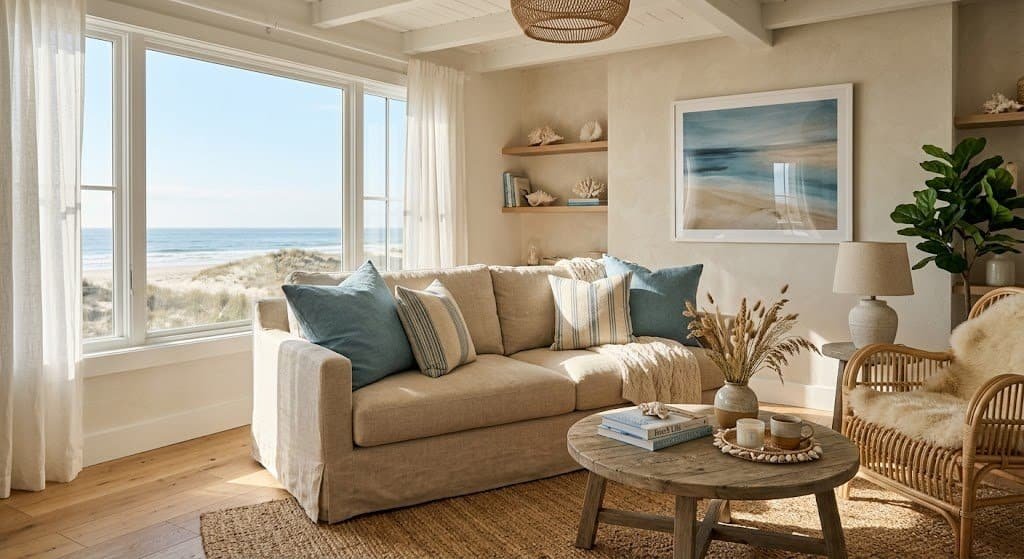
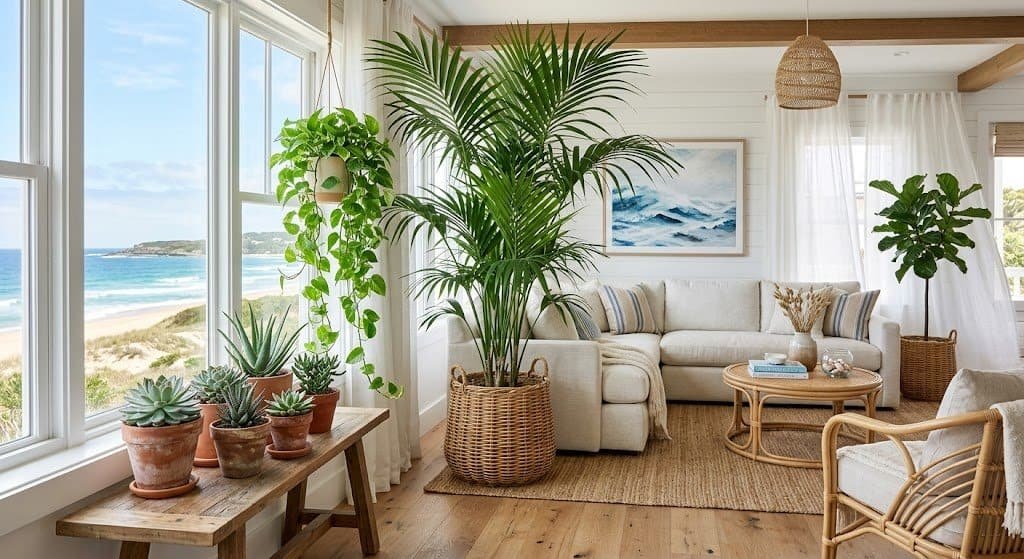
One of the reasons beach houses feel so distinctly different from other spaces is sensory. The beach engages every sense simultaneously: the sound of water, the smell of salt air, the feel of warm sand and cool breeze. You can’t replicate all of those things indoors, but texture — which is fundamentally a tactile experience translated into visual information — is something you absolutely can control, and layering natural textures is one of the most powerful tools in coastal interior design.In a coastal living room, the goal is to build a texture story using materials that come from or evoke the natural world. Jute or sisal rugs provide a coarse, fibrous base layer with a color and feel that genuinely evokes dry beach grass. Rattan and wicker furniture pieces — a side table, a basket, a chair — bring the woven texture of traditional coastal crafts. A chunky knit throw in natural cotton or wool adds warmth and visual weight. Wooden elements with a weathered or whitewashed finish evoke bleached driftwood. Linen curtains that move with air movement create the feeling of a coastal breeze even with the windows closed.The layering principle is important: it’s the combination of textures that creates richness. A room with only smooth surfaces feels clinical and modern. A room with only rough textures feels overwhelming and rustic in a way that reads more “farmhouse” than “coastal.” The coastal sweet spot is in the interplay: a smooth painted wall behind a rough jute rug, a sleek glass coffee table beside a rattan basket, a linen sofa covered in a chunky knit throw. These contrasts create depth and visual interest while staying firmly within the natural material vocabulary of the coast.
4. Use Driftwood as a Sculptural Decor Element
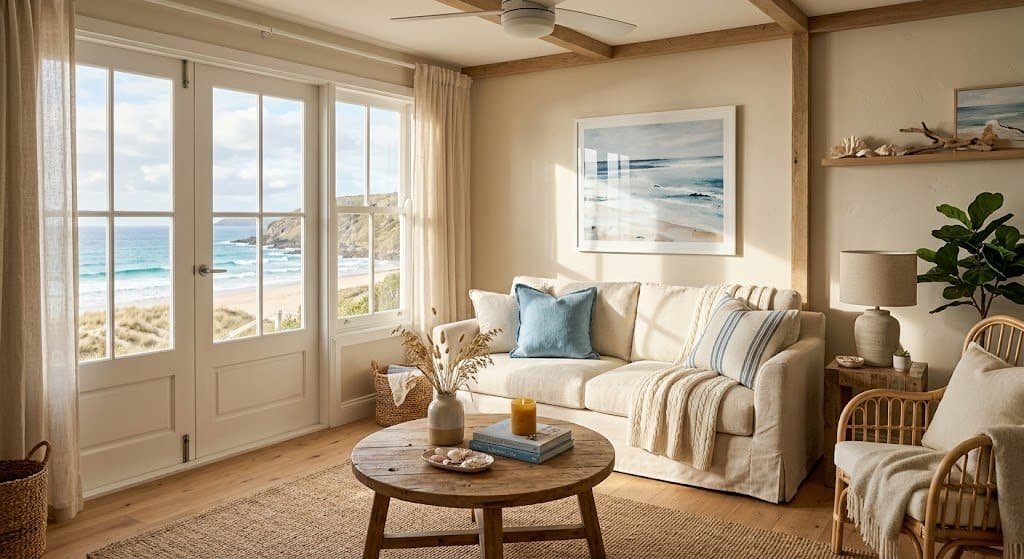
Driftwood is one of those materials that carries an entire emotional narrative in its shape. It tells you about water and time and the slow work of weather on wood. A single piece of driftwood displayed thoughtfully in a living room does more for a coastal atmosphere than a dozen generic seashell decorations from a home goods chain store.The key to using driftwood well is restraint and intentionality. A single large piece of driftwood — laid horizontally across a console table, propped in the corner of a room, or displayed on a floating shelf — functions as sculpture. It commands attention without demanding it. It reads as considered and individual rather than themed and generic. This distinction matters enormously: coastal decor that leans too hard into “beach themed” tips into novelty. Coastal decor that uses natural materials as genuine art objects feels like the real thing.Where to find driftwood: if you live near a coast, river, or lake, collect it yourself — pieces with interesting shapes, smooth surfaces, and grey-silver coloring are the most visually compelling. If you’re landlocked, Etsy has excellent sellers who source and ship real driftwood in a range of sizes. For large statement pieces, look at estate sales and antique markets — you can occasionally find beautiful large-scale driftwood pieces that would cost hundreds of dollars new for a fraction of that price.Driftwood also works beautifully as functional decor: a large forked piece makes a striking wall hook for bags and hats. A long flat piece sanded smooth becomes a floating shelf. A cluster of small pieces tied together with natural twine becomes a wall arrangement. The material is endlessly versatile, and because no two pieces are the same, every application of it is inherently original.
5. Install Shiplap or Tongue-and-Groove Wall Paneling
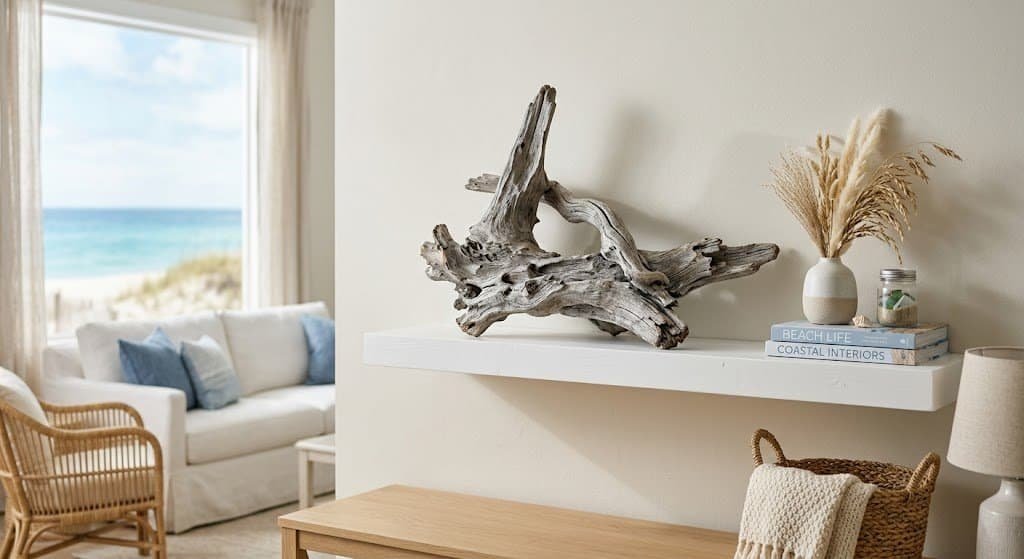
If you are willing to invest in one structural change to transform a living room into a coastal space, wall paneling — particularly shiplap or tongue-and-groove — is that change. Nothing else in the realm of wall treatments comes close to the immediate, dramatic impact of horizontal wood paneling painted white or left in a natural bleached finish. It is the visual signature of coastal architecture, and it works in rooms of every size and style.Shiplap is characterized by overlapping horizontal boards with a small reveal — a shadow gap between each board — that creates a subtle texture and a strong horizontal line pattern. That horizontal emphasis is important: horizontal lines in a room evoke the horizon line of the ocean, and the effect is both psychologically calming and visually grounding. Tongue-and-groove is a similar concept with boards that fit flush together rather than overlapping, creating a slightly smoother, more refined look.Both options are available as peel-and-stick or lightweight panel systems that don’t require professional installation, making them accessible to renters and homeowners who don’t want to undertake a major renovation. These faux shiplap systems have improved dramatically in recent years — the gap between a high-quality peel-and-stick shiplap panel and real installed shiplap is now difficult to detect at normal viewing distance.Color choices for paneling: bright white is the classic coastal choice, and it’s classic for a reason — it reflects light beautifully, makes small rooms feel larger, and provides a clean backdrop for natural decor elements. A soft white-grey or pale driftwood stain is a more nuanced alternative that feels warmer and more sophisticated. Navy on a single accent wall of shiplap is a striking option for those who want a bolder statement — it evokes deep water while maintaining the architectural coastal vocabulary.
6. Bring in Rattan and Wicker Furniture Pieces
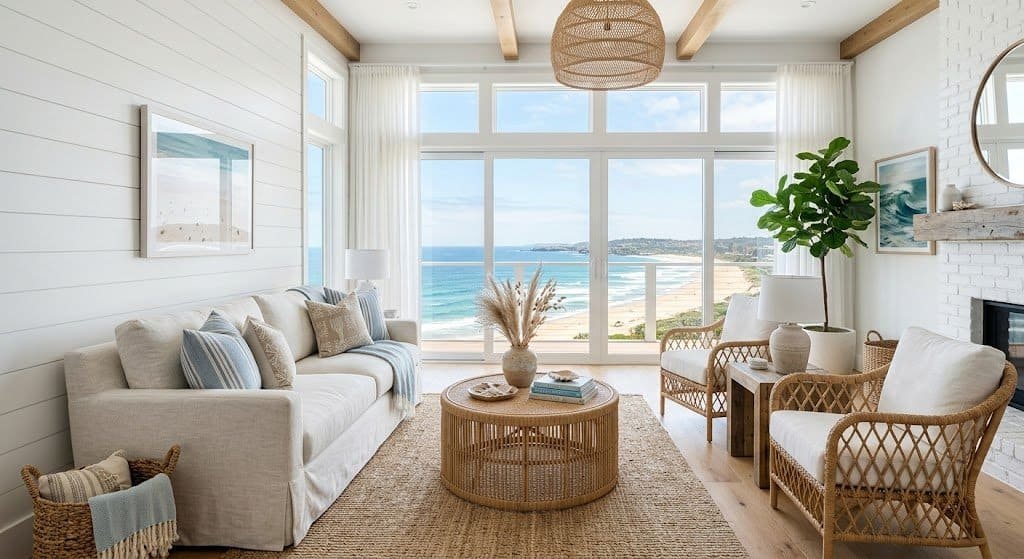
Rattan furniture has had one of the most remarkable design comebacks of the past decade. Once considered dated — the province of 1970s sunrooms and your grandmother’s enclosed porch — rattan has returned as one of the defining materials of contemporary coastal and bohemian interior design, and for excellent reasons. It is lightweight, durable, visually interesting, and deeply evocative of warm coastal living in a way that almost no other furniture material can match.In a coastal living room, rattan works best as an accent rather than a dominant material. A rattan coffee table paired with a linen sofa is a near-perfect coastal combination: the natural woven texture of the rattan against the soft drape of the linen creates exactly the kind of sensory contrast that makes a room feel layered and considered. A rattan side chair with a cushion in a muted blue or natural stripe adds seating and visual interest without the visual weight of an upholstered armchair. A rattan floor lamp with a white linen shade provides soft ambient light while reinforcing the natural material theme.The distinction between rattan and wicker is worth understanding: rattan refers to the material (the core of certain palms), while wicker refers to the weaving technique. Furniture can be wicker-woven from rattan, but also from bamboo, willow, or synthetic materials. For a coastal living room, natural rattan or bamboo weaves have the most authentic appearance — the warm honey-brown color and organic irregularity of natural materials cannot be replicated convincingly in synthetic alternatives.
7. Use Large-Scale Art That References the Ocean Without Being Literal
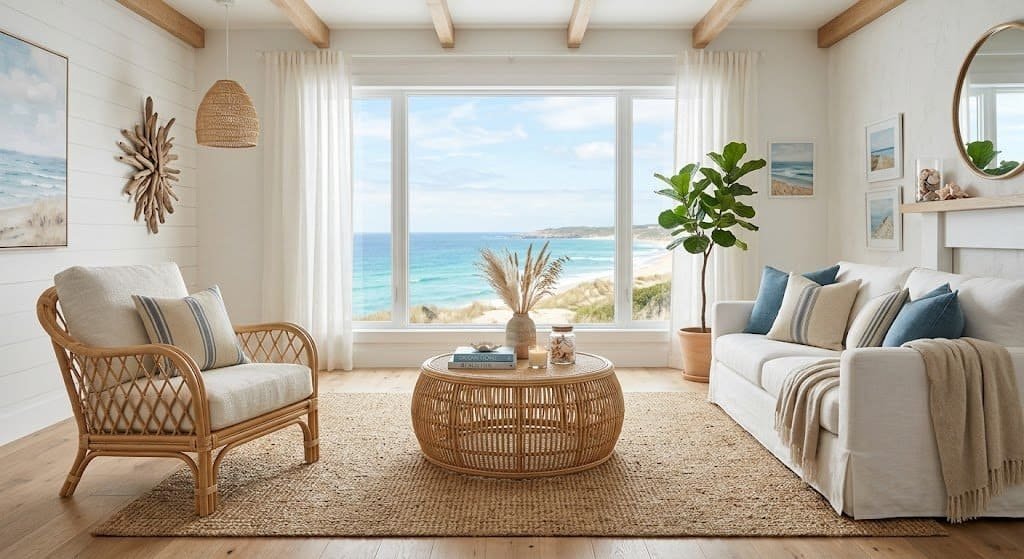
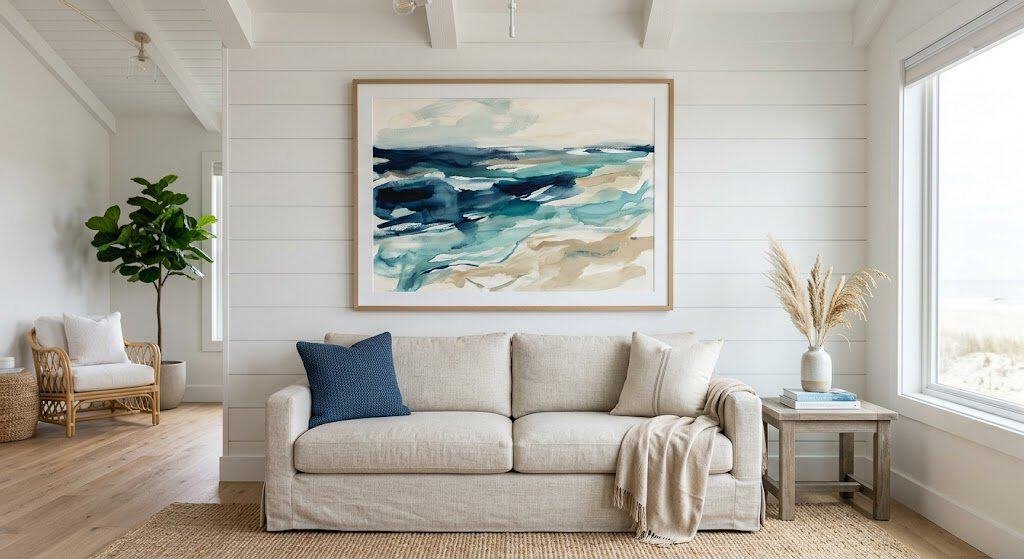
Coastal art is a category that ranges from transcendent to terrible, and most of the readily available commercial options fall closer to the latter end of that spectrum. A framed print of the word “BEACH” in rope font, a canvas of a cartoon sailboat, a mass-produced photograph of a pier — these things read as thematic costumes rather than genuine design choices. The living rooms that feel most authentically coastal typically display art that evokes the ocean without depicting it literally.What does that mean in practice? Abstract paintings in ocean-adjacent colors — deep blues, seafoam greens, sandy neutrals, slate grey — that suggest water movement through form and brushwork rather than representing a wave. Large-scale black and white photography of coastal landscapes — rocky shores, tall grass bending in wind, an empty beach at low tide — that capture the mood of the coast rather than a cheerful postcard version of it. Hand-drawn or painted botanical prints of coastal plant species — sea oats, beach grass, succulents common to coastal dunes — that bring the ecology of the shore indoors in a subtle way.Size matters enormously with coastal art. A single large-scale piece — something that covers 24 by 36 inches or larger on a primary wall — makes a more powerful and sophisticated statement than a collection of small framed prints in a gallery wall arrangement. The gallery wall approach can work in coastal spaces, but it requires careful curation to avoid feeling cluttered and tourist-shop-adjacent. When in doubt, go larger and fewer rather than smaller and more.Sources for genuinely beautiful and affordable coastal art: Society6 and Minted offer original artist work in a range of sizes and price points. Etsy is exceptional for abstract and original paintings from independent artists. Your own photographs — printed large and framed simply — can be as effective as anything you’d purchase, particularly if they’re images you took at a meaningful coastal location.
8. Replace Heavy Curtains With Sheer Linen Drapes
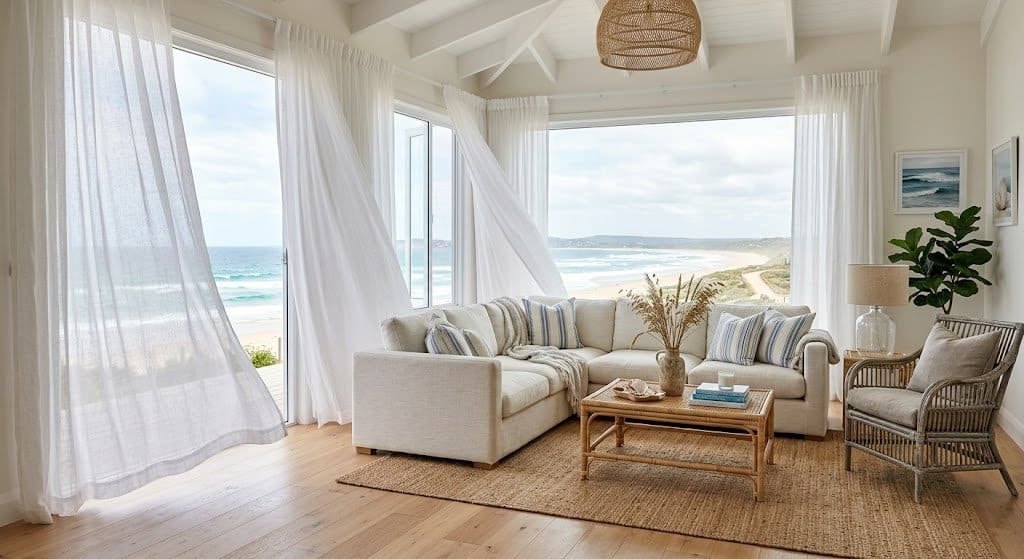
Light is the single most transformative element in any interior space, and in a coastal living room, the goal is to maximize it while softening it — to create the feeling of light coming through salty air rather than sharp interior light bouncing off painted walls. The treatment you choose for your windows will determine whether you achieve that or fall short of it.Heavy curtains in dark fabrics — velvet, jacquard, blackout lining — are the enemy of coastal light. They absorb rather than diffuse, they feel formal and weighty in a space that wants to feel buoyant, and they physically block the connection between indoors and outdoors that is central to coastal design. Even in a practical sense — if you need window coverings for privacy or to block morning sun — there are coastal-appropriate solutions that don’t sacrifice the light quality.Sheer linen drapes in white or natural undyed linen are the ideal coastal window treatment. They allow light to pass through while diffusing it into a soft glow that fills the room evenly. They move with any air movement from open windows, creating the impression of a coastal breeze. They hang with a slight natural texture that adds visual interest to the window wall without the decorative complexity of valances or curtain rods with elaborate finials.For privacy without sacrificing light quality, layer a cellular shade or simple roller shade in white or warm white behind the sheer panels. During the day, the sheers are drawn and the space is full of soft natural light. At night or when privacy is needed, the shade rolls down behind the sheers, maintaining the soft drapery look while blocking the view from outside. This layered approach handles the practical requirements without compromising the coastal aesthetic at any point.
9. Add a Jute or Sisal Rug as the Foundational Floor Layer
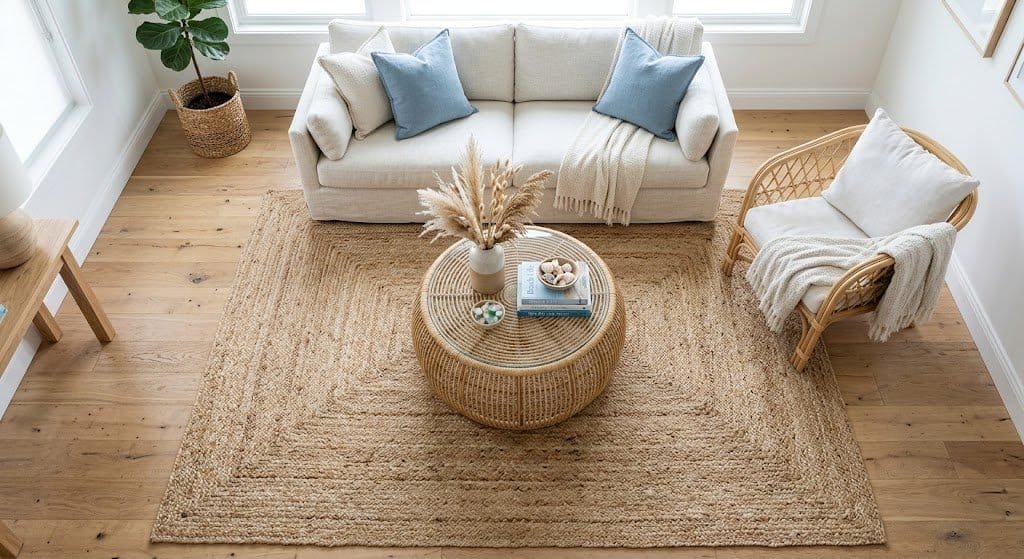
The rug in a living room establishes the floor, which is the literal foundation of everything else in the space. In a coastal living room, the rug choice carries enormous visual and tactile weight, and a jute or sisal rug is the most authentic and effective option available at almost any price point.Jute is a plant fiber woven into a coarse, warm-brown textile with the color and feel of dried coastal grass. It is inherently textured, entirely natural, biodegradable, and — importantly for coastal design — it reads as organic and grounded rather than soft and formal. A large jute rug placed under the main seating arrangement anchors the room visually, provides a natural color counterpoint to softer blues and whites above it, and adds a layer of texture that immediately registers as coastal.Sisal is a similar option, slightly more uniform in texture and slightly more durable in high-traffic areas. Both jute and sisal are available in a wide range of sizes and prices — a quality 8-by-10 jute rug can be found for $80–150 from retailers like World Market, Rugs USA, and Amazon, making this one of the most cost-effective upgrades available in coastal interior design.For comfort underfoot, always pair a natural fiber rug with a rug pad: jute and sisal can feel rough without the cushion of a quality pad beneath them, and the pad also prevents slipping and protects the floor. If you have young children or pets and are concerned about the rougher texture of jute, a jute-look rug in a soft cotton or polypropylene weave provides the aesthetic benefit without the scratchy surface — the visual difference is minimal, though the tactile experience is quite different.
10. Display Sea Glass, Shells, and Found Objects With Intention
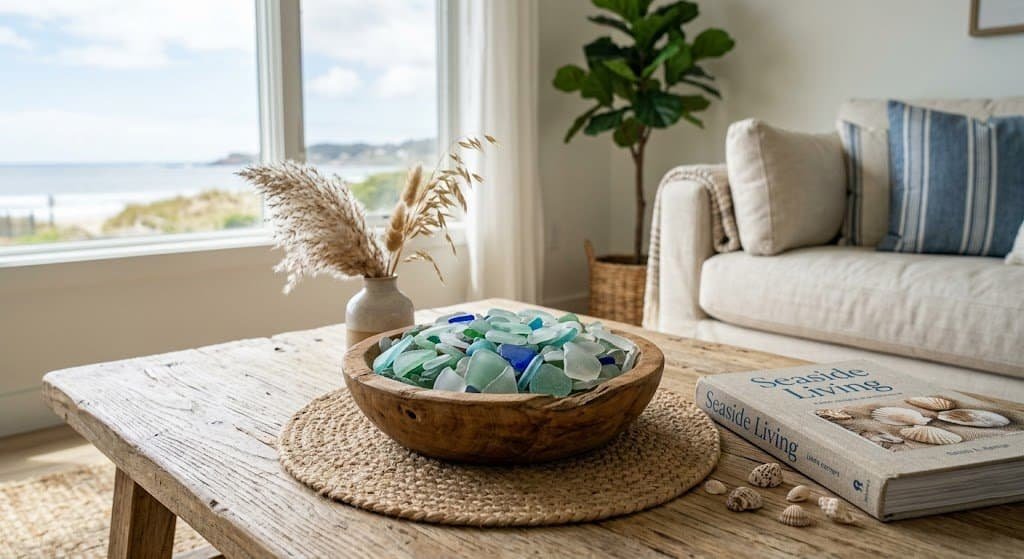
The difference between a coastal living room that feels curated and authentic and one that feels like a souvenir shop is almost entirely in how natural objects — shells, sea glass, coral, pebbles — are displayed. These things are genuinely beautiful. They connect us to actual experiences at the actual ocean. The problem is not the objects themselves but the way they’re typically deployed: crammed into a glass bowl by the door, hung as a wreath on the wall, glued to a picture frame, or arranged in ways that announce “beach decor” rather than quietly evoking it.The principle to follow is gallery curation rather than collection display. Choose three to five objects that are genuinely beautiful — a particularly fine piece of sea glass, a large and perfect shell, an unusual piece of driftwood, a smooth sea-worn stone in an interesting color — and display them individually or in very small groupings on dedicated surfaces with space around them. A single large conch shell placed on a stack of design books on a coffee table is a beautiful object. Fifteen mixed shells in a glass vase are a theme prop.Sea glass deserves particular attention because its colors — frosted white, soft green, cobalt blue, rare amber and red — are among the most naturally beautiful of any small decorative object. A collection of sea glass displayed in a clear glass cylinder or spread across a small mirrored tray becomes genuinely luminous in natural light. The frosted texture of sea glass also photographs exceptionally well, which matters for anyone documenting and sharing their home on social platforms.
11. Choose Light Wood Floors or Whitewashed Wood Finishes
Flooring is one of the highest-impact and highest-cost decisions in any room, and in a coastal living room, the floor color and finish sets the entire tonal direction of the space. Dark hardwood floors — espresso stains, dark walnut, ebonized finishes — work beautifully in many interior styles but actively fight against coastal design, which depends on lightness, warmth, and the visual expansion that comes from a pale floor reflecting natural light upward.The ideal floor for a coastal living room is light. Natural oak in its undyed state — the warm, honey-golden color that comes from simply sealing raw oak without staining — is perhaps the perfect coastal floor: warm enough to feel welcoming, light enough to make rooms feel airy, and natural enough in color and grain to belong in a room full of other organic materials. Wide-plank formats — boards 5 inches wide or wider — amplify the coastal feeling by referencing the planked floors of traditional beach houses and boardwalks.Whitewashed or bleached wood finishes take the coastal floor concept further, creating a pale, slightly grey-white surface that echoes weathered boardwalk wood and bleached driftwood. This look is more specific and more committed — it reads unmistakably as coastal, which is both its strength and its limitation. It’s the right choice for rooms where the coastal commitment is total rather than subtle.For those who can’t change their floors — renters, or homeowners with floors in good condition that are simply the wrong color — a large area rug handles the problem elegantly. A jute or sisal rug covering the main seating area effectively replaces the visual floor within the primary zone of the room, and the floor color beneath it becomes largely irrelevant to the room’s overall character.
12. Incorporate Nautical Rope Details Without Going Overboard
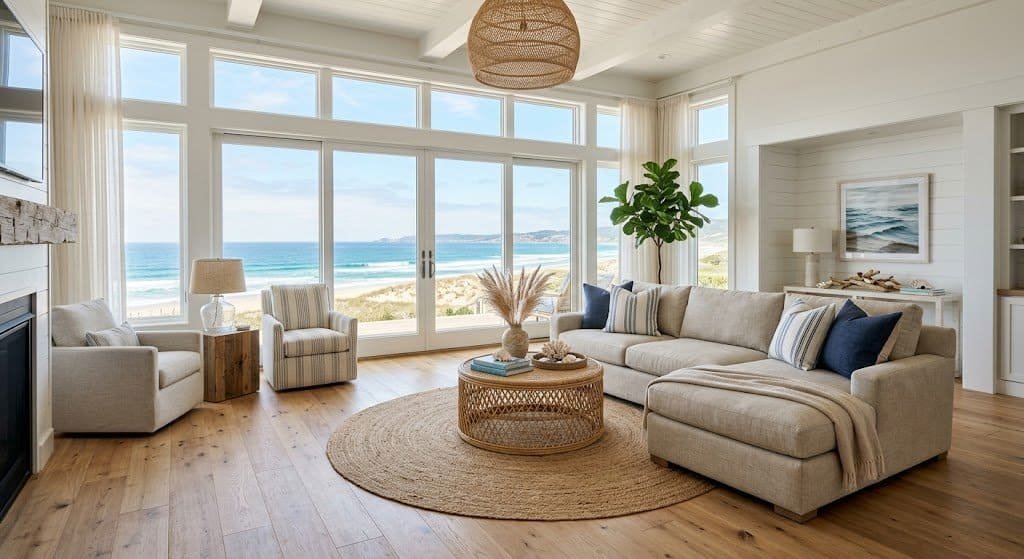
Nautical rope is one of those coastal design elements that has enormous potential and is almost universally executed badly. In its worst form, it appears as thick coils of anchor rope draped around everything, as a lamp base wrapped in rope from top to bottom, as curtain tie-backs that look salvaged from a fishing boat. The problem isn’t the material — rope is beautiful, natural, and genuinely coastal — it’s the heavy-handedness of how it’s typically applied.Used with restraint, rope becomes a subtle and beautiful coastal accent. A single thick rope used as a curtain tie-back against white linen drapes is elegant. A rope-wrapped vase or candle holder on a side table provides texture without announcing itself. A framed piece of decorative knot work — the kind sailors have made for centuries — hung as wall art in a simple white frame is genuinely beautiful and historically authentic. A rope-handled basket used for storing throw blankets is functional and attractive without feeling themed.The restraint principle applies doubly to nautical themes in general. Anchors, compasses, ship wheels, and sailor’s knots are legitimate cultural symbols of coastal and maritime life, but they need to be deployed as occasional accents rather than as a comprehensive theme. One nautical knot print in a well-chosen frame reads as a design choice. Five nautical elements in the same room read as a nautical store. The difference is the difference between a coastal living room and a seaside gift shop.
13. Create a Reading Nook With a Hammock Chair or Swing
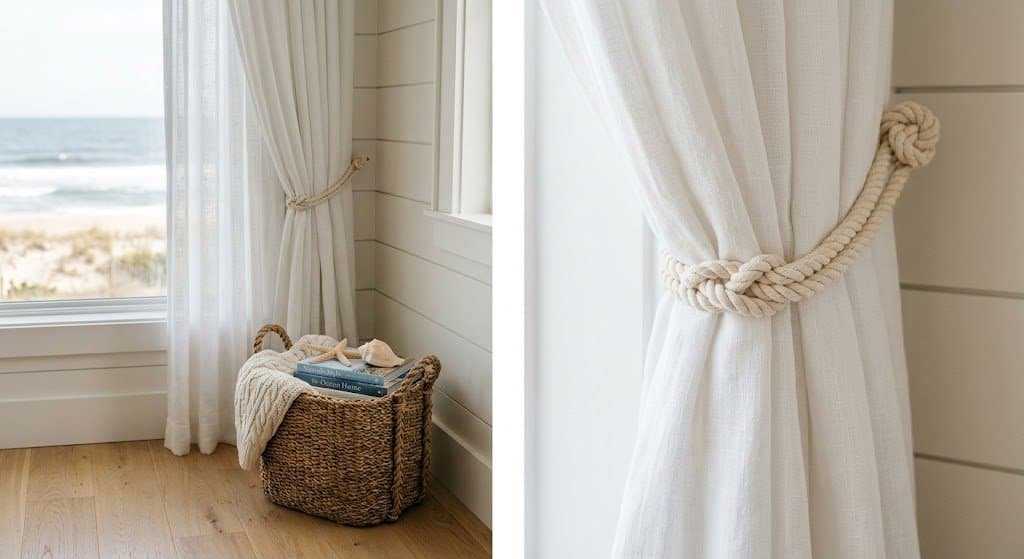
Nothing communicates “relaxed coastal living” quite as effectively as a hammock chair or hanging swing chair positioned in a living room corner. It is the kind of furniture choice that makes practical and aesthetic statements simultaneously: it is genuinely comfortable in a way that invites slow, unhurried rest; it moves gently with any air movement; and it reads as deeply, authentically casual in a way that no conventional armchair can fully replicate.Hanging chairs come in a range of forms suitable for indoor installation. A macramé hammock chair in natural cotton with wooden spreader bars evokes the handmade, artisanal quality of coastal craft traditions. A rattan or wicker egg chair hanging from a floor stand — which requires no ceiling installation — is perhaps the most accessible option for renters and those not willing to install a ceiling hook. A simple canvas hammock chair from REI or similar outdoor retailers, hung from a ceiling beam, is the most minimal and casual version.The corner positioning matters: a hanging chair that is clearly set apart from the main seating arrangement — with a small side table nearby, a good reading light above it, and perhaps a small stack of books beside it — creates a defined room within the room. It’s the nook that everyone gravitates to first, that guests photograph and comment on, and that becomes the most-used seat in the house despite often being the least conventional one.
14. Use Mirrors Strategically to Amplify Light and Space
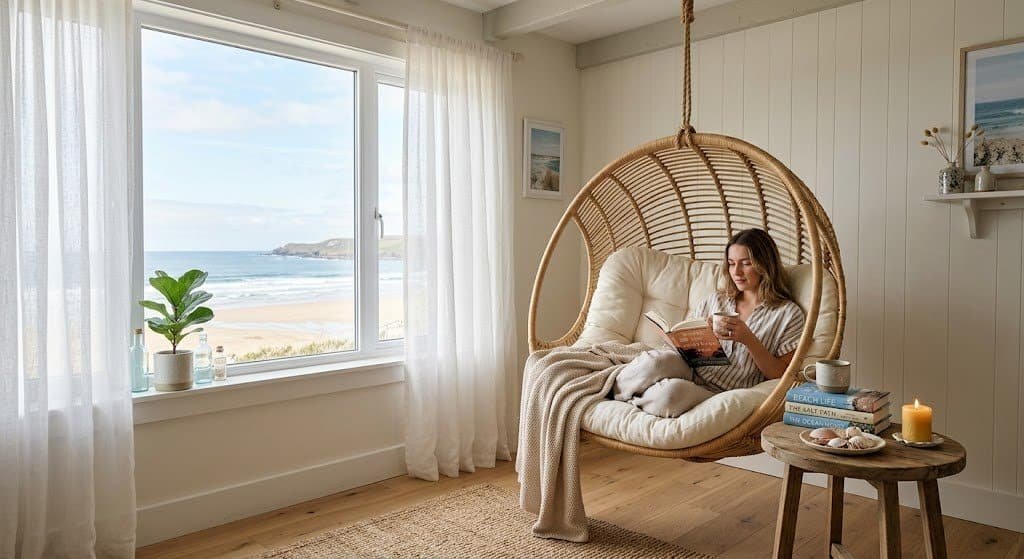
Mirrors in interior design function as light multipliers — they capture natural light from windows and redistribute it into areas of the room that would otherwise remain dim. In a coastal living room, where the goal is always more light, more airiness, and more sense of visual expansion, mirrors are one of the most powerful tools available, and they work regardless of the room’s actual size or natural light situation.The most effective mirror for a coastal living room is a large round or oval mirror with a natural frame — driftwood, rattan, rope, or whitewashed wood. Round shapes soften the angular geometry of a room, which supports the organic, natural quality of coastal design. A round mirror 24 to 36 inches in diameter hung on the wall opposite or adjacent to the primary window captures and reflects the most light from the widest angle.A sunburst mirror in natural materials — rattan spines radiating from a central mirror circle — is another beautiful option that has become strongly associated with coastal and bohemian design. Positioned on a light wall, it reads as sculptural art as much as it reads as a mirror, providing both functional light reflection and decorative interest in a single piece.For maximum impact in a smaller room: lean a large floor mirror against the wall rather than hanging it. A floor mirror 48 inches tall or taller, angled slightly toward the window, captures nearly ceiling-to-floor light and reflects the room back on itself in a way that can make a small space feel genuinely large. The leaning angle also feels appropriately casual — deliberate but effortless, which is exactly the tonal quality that coastal design aspires to.
15. Introduce Coastal Plants — Sea Grass, Succulents, and Palms
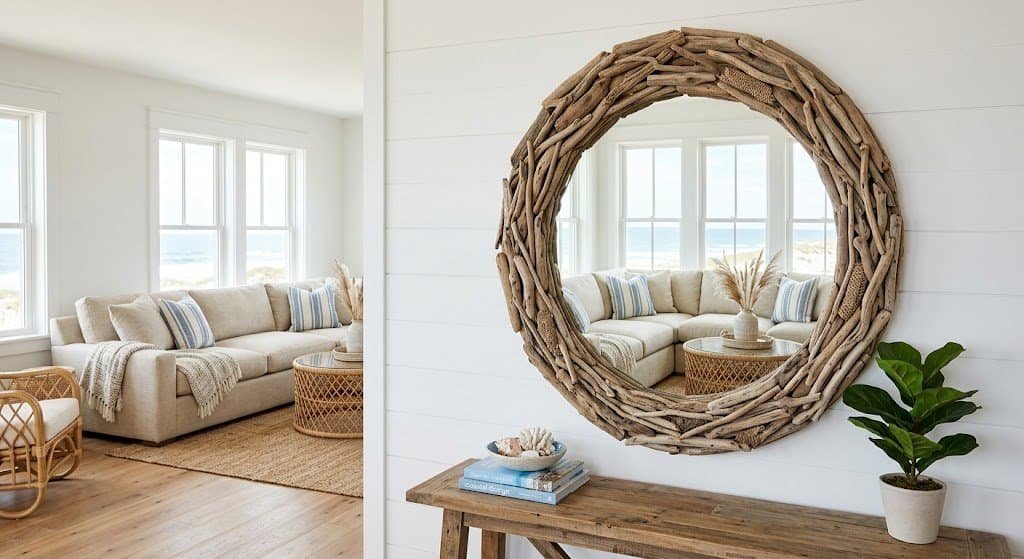
Living plants in a coastal living room do something that no amount of decor can fully replicate: they bring actual life into the space. The movement of plant leaves, the presence of something growing, the oxygen quality that plants contribute to a room — these are sensory experiences that connect us to the natural world in ways that are genuinely good for us. For a coastal room that is trying to evoke the feeling of being at the shore, plants are not decoration. They are atmosphere.The plants that work best in coastal rooms are those that naturally evoke coastal and tropical environments: tall indoor palms — Areca palms, parlor palms, and Kentia palms — bring immediate tropical warmth and height to a room while requiring relatively modest care. Succulents and cacti in sandy, gritty soil in terracotta pots evoke the drought-tolerant plant life of coastal dunes and cliffs. Snake plants (Sansevierias) with their tall, architectural leaves have a graphic quality that works beautifully in more modern coastal spaces. Trailing pothos in a hanging planter near a window creates a lush, flowing softness that contrasts beautifully with the harder textures of rattan and driftwood below.Planters and pots matter as much as the plants themselves. Terracotta is the natural choice — its warm orange-red color is inherently earthy and coastal, and it ages beautifully with use. Woven baskets used as pot covers bring texture and warmth to any plant. White ceramic pots provide clean contrast. Avoid plastic pots in colors that don’t integrate with the room’s palette — the visual effect of a bright purple plastic pot in a soft coastal room is jarring in a way that is difficult to fix with any amount of surrounding decor.
16. Style Your Coffee Table Like a Curated Coastal Vignette
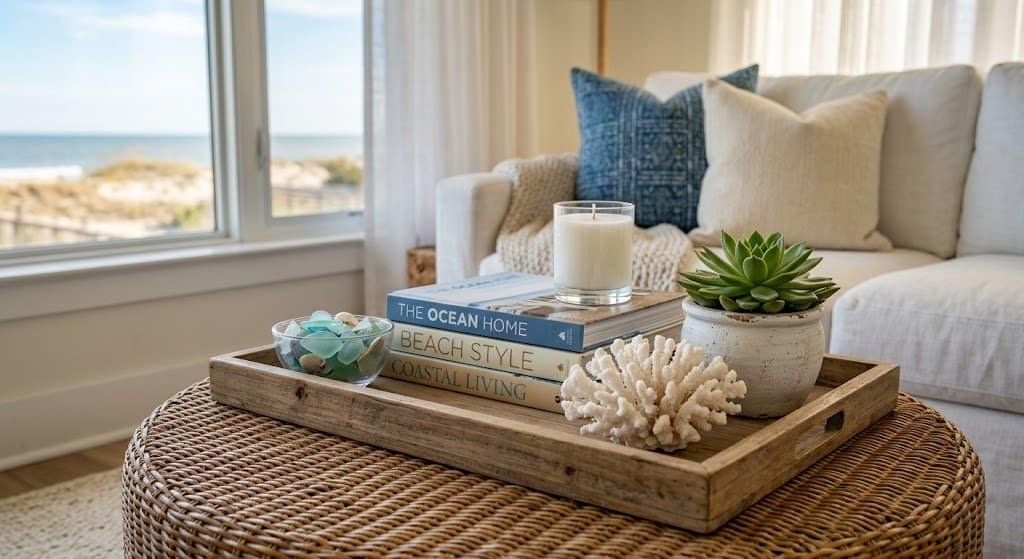
The coffee table is the most closely observed surface in a living room — it sits at eye level when you’re seated, it’s the first thing you see when you walk into the room, and it’s the surface that accumulates and displays the small objects that say the most about the people who live there. In a coastal living room, a well-styled coffee table vignette is one of the highest-impact styling moves you can make for the lowest investment.A coastal coffee table vignette typically works in layers and odd numbers. Start with a low tray in natural materials — raw wood, rattan, woven grass — as the organizing element that defines the vignette’s footprint. Within the tray, arrange three to five objects at varying heights: a stack of coffee table books (design books with blue or white spines work beautifully), a small sculptural object like a piece of sea glass or a coral specimen, a candle in a natural wax and a soft container, and something living — a small succulent, a sprig of dried pampas grass, or a few fresh eucalyptus stems.Outside the tray, a small lower item — a coaster set in natural stone or cork, a single flower bud vase, a small dish of pebbles — grounds the arrangement and creates the sense of thoughtful overflow rather than rigid containment. The whole vignette should look easy and organic rather than arranged — which paradoxically requires more thought and intentionality than something that looks deliberately styled.
17. Layer Lighting for Morning-to-Evening Coastal Ambiance
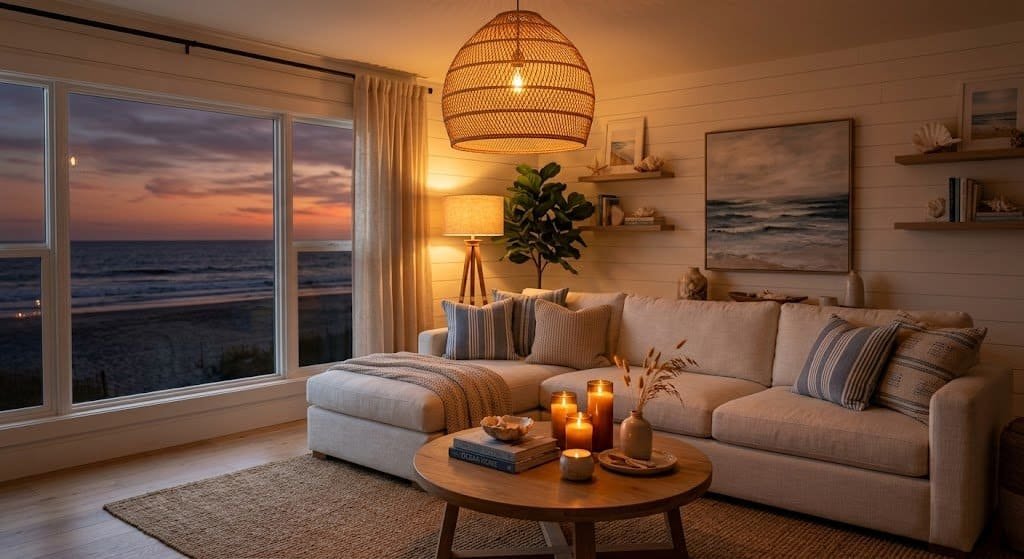
Lighting design is the element that most consistently separates a truly beautiful room from one that is merely well-furnished. A coastal living room that looks stunning in morning natural light can feel flat and lifeless in the evening if its artificial lighting is not layered and warm. Understanding how to build a lighting plan that works through all light conditions is fundamental to creating a room that genuinely lives up to its potential at every hour.Coastal lighting layering works in three levels. The ambient layer is the general illumination of the room: ceiling fixtures, recessed lights, or a central chandelier. For coastal rooms, a rattan or woven fiber pendant light as the primary ambient fixture is both functional and beautiful — it provides overhead light while functioning as a sculptural ceiling accent that reinforces the natural material theme of the room. Avoid harsh cool-white bulbs in any fixture; warm white LEDs at 2700K or 3000K replicate the quality of evening coastal light most accurately.The accent layer adds targeted illumination to specific areas: a floor lamp behind a reading chair, a table lamp on an end table beside the sofa, a small lamp on a console table. These lights create pools of warm light that make a room feel inhabited and comfortable rather than evenly and institutionally lit. In a coastal room, lamps with bases made from natural materials — ceramic in sandy or ocean colors, rattan, driftwood, whitewashed wood — keep the material story consistent through every element of the room.The mood layer uses candles and low-level accent lights to create the warm, flickering quality of light that our nervous systems associate most strongly with relaxation and safety. Several pillar candles in natural beeswax or white paraffin grouped on the coffee table, a string of warm LED fairy lights draped across a shelf or along a window frame, or a wax melt warmer in a coastal scent — sea salt, driftwood, ocean breeze — engages both the visual and olfactory senses simultaneously, creating an evening ambiance that feels genuinely coastal even hours from any actual beach.
18. Edit Ruthlessly — Coastal Style Is About Breathing Room
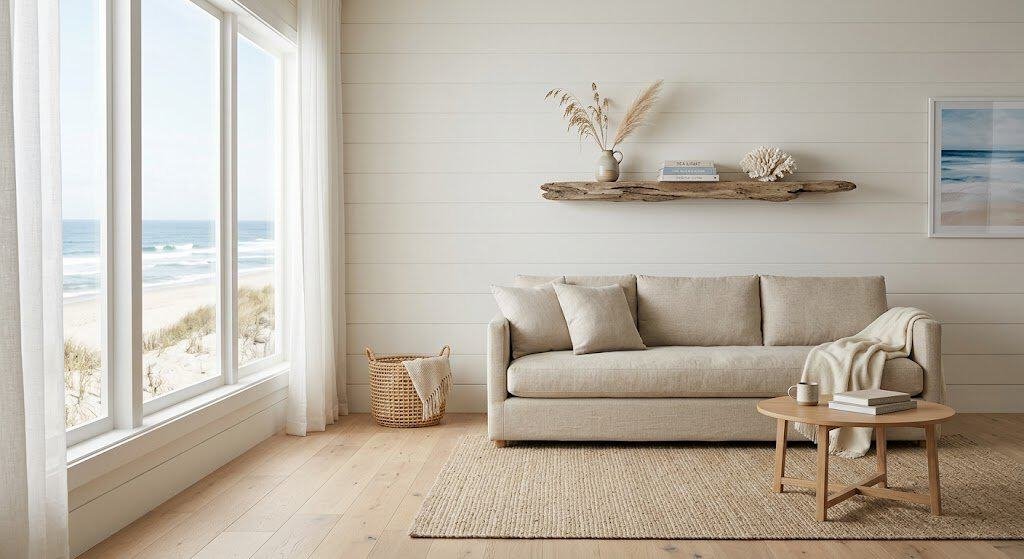
The final idea in this guide is, in many ways, the most important: a coastal living room that truly feels like the beach is not one with the most coastal objects in it. It’s one with the right amount of space around each object. The feeling of standing on a beach comes as much from what isn’t there — the absence of walls, the open horizon, the uncluttered sky — as from what is. A coastal living room should carry some of that spaciousness indoors, and that means editing relentlessly.Go through your living room and remove anything that doesn’t actively contribute to the coastal feeling you’re trying to create. This doesn’t mean throwing things away — it means putting them in a different room, boxing them for a season, or donating them to create space for what you do want to keep. Every surface should have breathing room around the objects on it. Every piece of furniture should have walking space around it. The walls should not be entirely covered — some empty wall space is not a failure of decoration but an intentional design choice that lets the room breathe.The editing principle extends to color: if you’ve chosen a coastal palette of sand, white, muted blue, and natural wood tones, every object in the room that falls outside those tones introduces visual competition that the room has to absorb. A bright red throw pillow in an otherwise coastal room doesn’t just not fit — it actively undermines the feeling of the whole space by introducing a competing visual signal. Editing for color coherence is one of the fastest and most effective ways to make an existing room feel more coastal without adding a single new object.What remains after editing should feel essential rather than arbitrary. Every piece should be something you’d choose again, something that earns its place in the room through beauty or function or emotional meaning. That selectivity — that sense of each object being chosen rather than accumulated — is the quality that separates a coastal living room that truly feels like the ocean from one that merely looks like it’s trying to.
Putting It All Together: The Coastal Living Room You’ve Always Wanted
When I finally finished the last round of changes to our living room — the sheer linen curtains were the last thing, hung on a gray November afternoon when the light outside was doing nothing for anything — I sat down on the sofa, looked at the room, and felt something settle. The jute rug. The driftwood shelf with its five pieces of Maine sea glass. The round rattan mirror catching the lamp light in the corner. The white walls and the wide-plank floor. The single large abstract painting in deep blue and sandy cream above the fireplace.It looked like the coast. Not like a decorating project that referenced the coast. Like the coast itself had come to live in a cornfield in the Midwest and made itself comfortable.That’s what all 18 of these ideas are working toward, individually and collectively. Not a themed room, not a collection of beach objects, but a space that carries the emotional signature of being at the sea: open, light, quiet in a warm way, full of natural materials and natural colors, generous with space and air and the soft quality of light coming through thin curtains.You don’t need all 18 ideas at once. Choose three or four that match your current space, your budget, and your sense of what your room needs most. Build from there. The coastal living room you’re imagining is closer than you think.Save this article to Pinterest and share it with someone who needs a little more beach in their life.