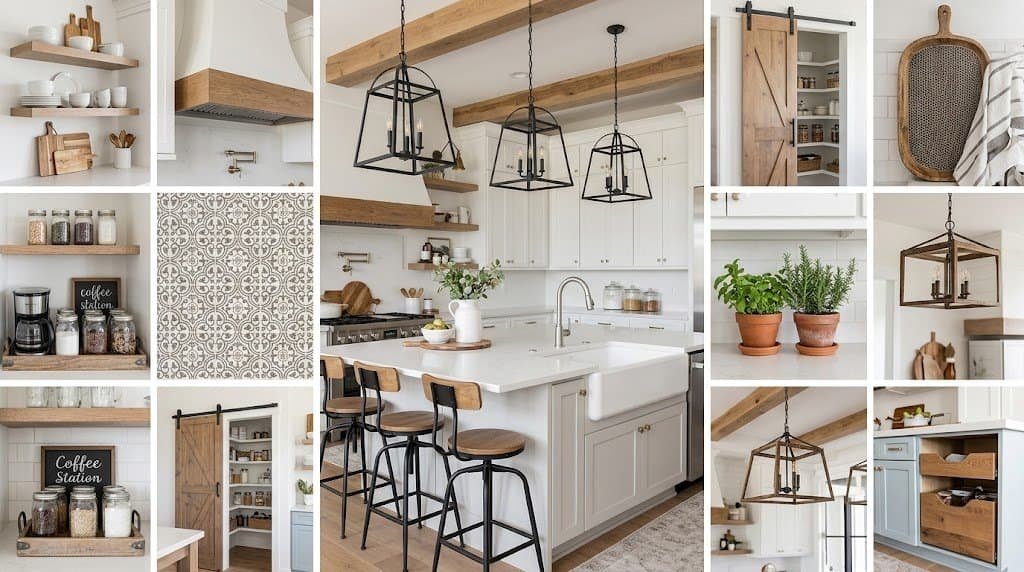
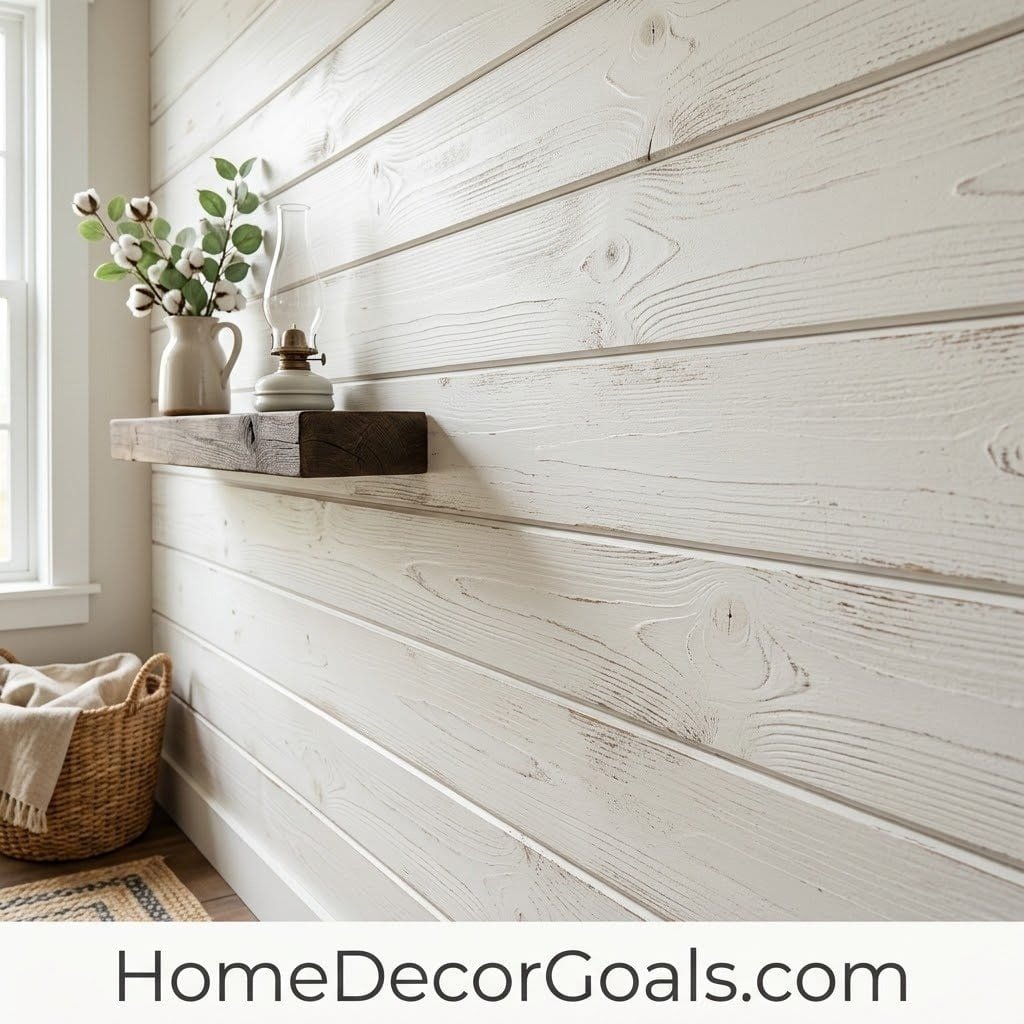
1. Add Shiplap Accent Walls for That Instant Farmhouse Feel
If there is one single element that screams “farmhouse kitchen” louder than anything else, it is shiplap. Shiplap is horizontal wooden planking with a small gap between each board, and it has become the defining feature of the modern farmhouse aesthetic — largely thanks to Joanna Gaines and the massive cultural impact of HGTV’s Fixer Upper. But here’s what most blogs won’t tell you: you don’t need to shiplap every wall to make it work.When I did my own kitchen, I shiplapped just one wall — the one behind the stove, which also served as our backsplash area. We painted it a warm white (Sherwin-Williams “Alabaster” is my absolute go-to recommendation), and the transformation was jaw-dropping. The texture it added to the room made the whole kitchen feel intentional and designed, not just decorated.If you’re worried about the cost, real wood shiplap can run $1–$3 per square foot. But there’s a budget hack: many homeowners use MDF planks or even peel-and-stick shiplap panels that look nearly identical at a fraction of the price. For a single accent wall in an average kitchen, you’re looking at anywhere from $50–$200 for materials if you DIY it. That is an absolutely incredible return on investment when you consider the visual impact.Pro tip: Don’t paint shiplap a harsh, cool white. Warm whites and creamy whites photograph better, feel more inviting, and work harmoniously with wood tones and warm metals like brass and bronze — which, as you’ll see, are everywhere in farmhouse design.
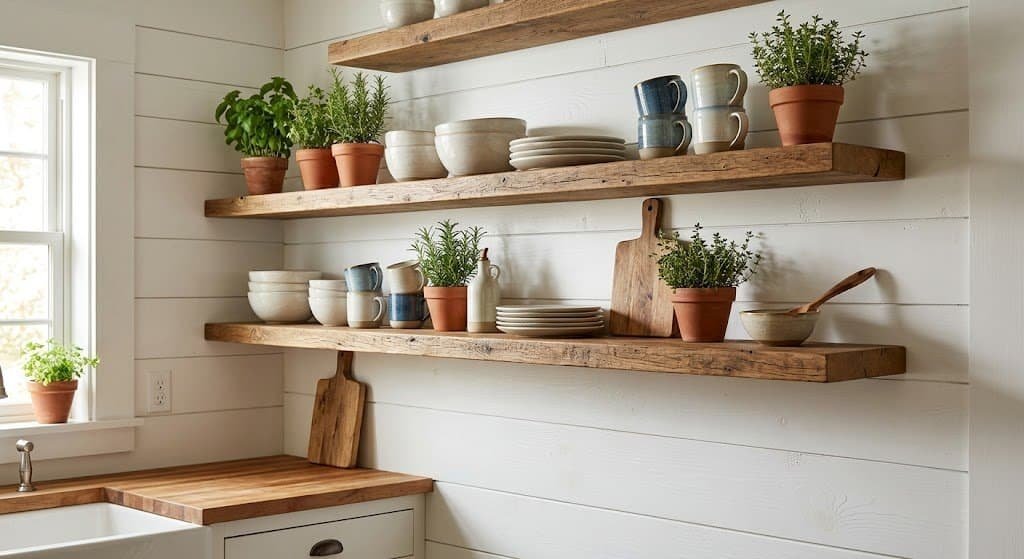
2. Install Open Wooden Shelves Instead of Upper Cabinets
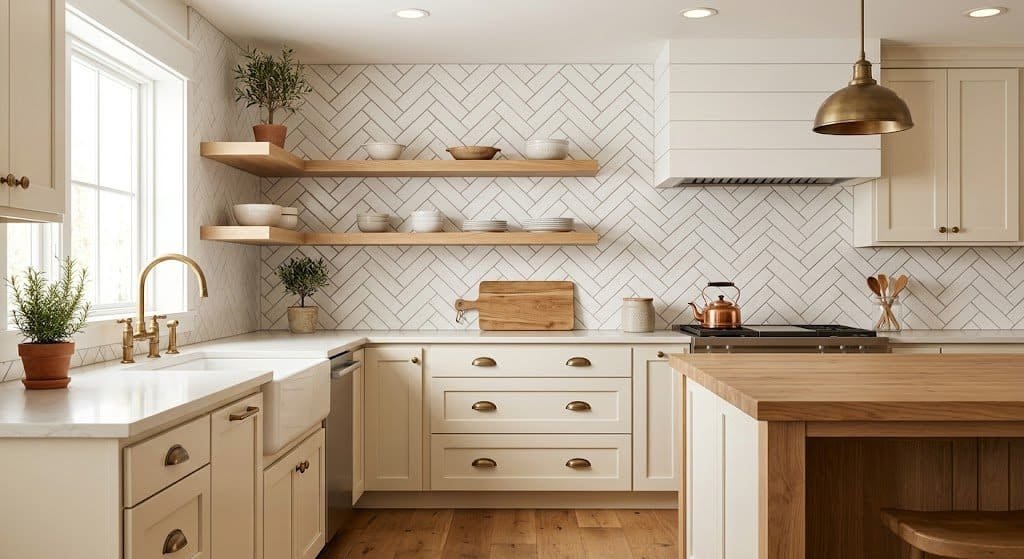
This one is controversial — and that’s exactly why I love it. When we removed our upper cabinets on one side of the kitchen and replaced them with floating reclaimed wood shelves, my mother-in-law thought we had lost our minds. “Where will you put everything?” she asked. Two years later, she asked us to do the same in her kitchen.Open shelving is a cornerstone of the modern farmhouse kitchen for good reason. It opens up the space visually, makes the kitchen feel larger and airier, and forces you to be intentional about what you display — which in turn encourages you to invest in beautiful, cohesive kitchenware. Those matching white ceramic plates you always wanted? Now you have a reason to buy them. Those vintage mason jars for storing grains? They’re decor now, not just storage.For the shelves themselves, reclaimed wood from a local lumber yard or salvage shop gives you the most authentic farmhouse look. You want wood with character — knots, grain variation, maybe even a little rough texture. The brackets matter too: go for black matte iron pipe brackets or simple chunky black metal L-brackets. They add an industrial edge that gives the “modern” part of modern farmhouse its identity.Keep your shelves curated. A mix of functional items (stacked plates, glasses, cutting boards) with decorative elements (small plants, a vintage crock, a ceramic jar) creates a styled-but-lived-in look that makes people stop scrolling on Pinterest every single time.
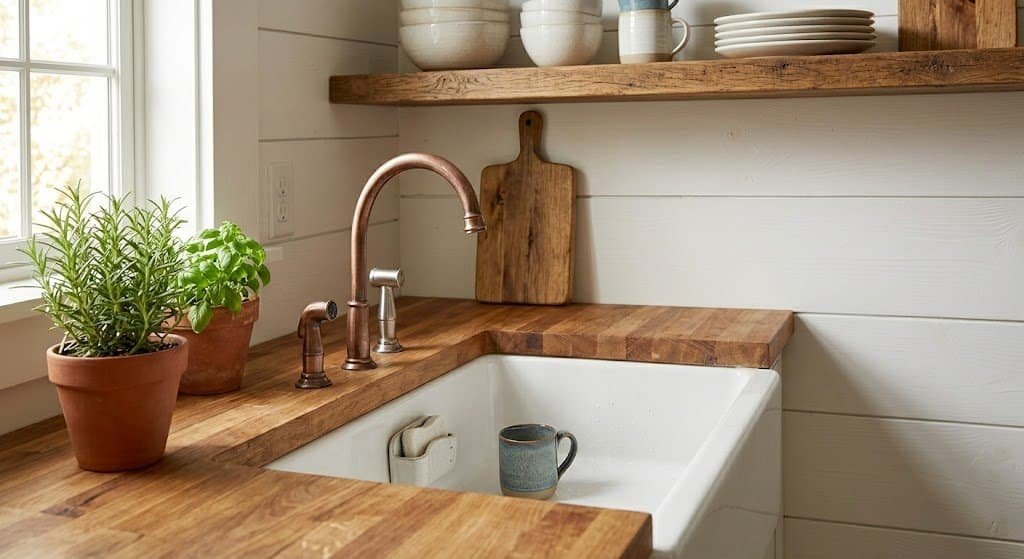
3. Choose a Farmhouse (Apron-Front) Sink as Your Kitchen Centerpiece
The farmhouse sink — also called an apron-front sink — is the crown jewel of the farmhouse kitchen. There is something about its generous, deep basin and exposed front panel that feels both deeply practical and incredibly romantic at the same time. It is the kind of sink that makes you actually want to do the dishes.My own farmhouse sink story is one of my favorites to tell. We found a gorgeous white fireclay apron-front sink at a local home improvement clearance center — a return with a tiny chip on the underside that you’d never see once installed. We paid $180 for a sink that retails for $700. It is the single most-commented-on element of our kitchen, every single time someone visits.The most popular materials for farmhouse sinks are fireclay, cast iron, and stainless steel. Fireclay gives you that classic, pristine white look and is incredibly durable. Cast iron with enamel coating is heavier but offers gorgeous color options. Stainless steel is the most practical and easiest to maintain, though it has a slightly more modern, industrial feel.Whatever material you choose, position your sink under a window if at all possible. Nothing elevates a farmhouse kitchen quite like washing dishes while looking out at a garden, a backyard, or even just a small window box with fresh herbs. That combination — apron sink plus window view — is one of the most universally loved shots in all of kitchen design photography, and for very good reason.
4. Add a Sliding Barn Door for Function and Style
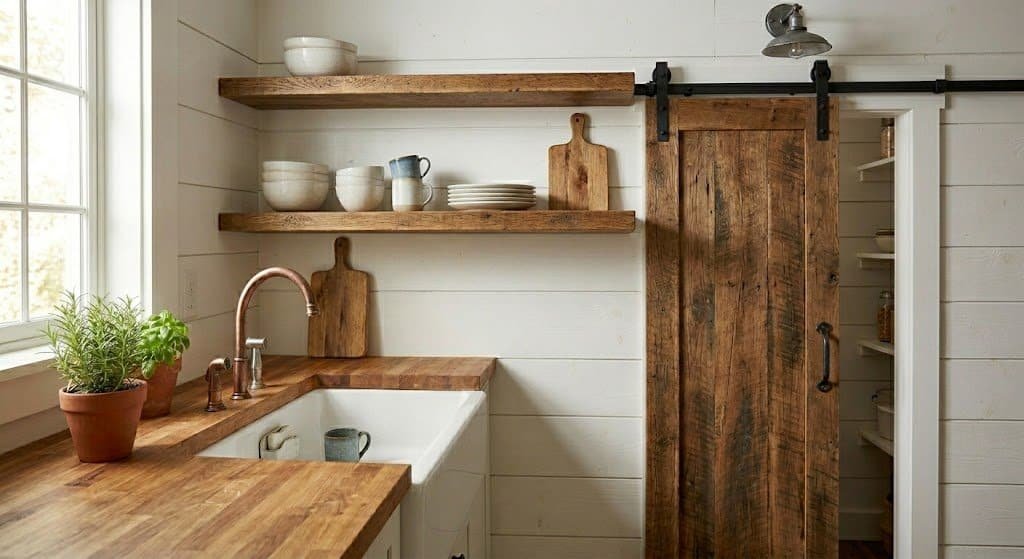
The sliding barn door is one of those design elements that works on every level simultaneously. Practically, it saves space — no door swing means more usable floor space in a busy kitchen. Aesthetically, it is a statement piece that instantly communicates warmth, character, and personality. And from a decor standpoint, it gives you a large surface to play with: stain it dark walnut for drama, whitewash it for coastal farmhouse vibes, or paint it in a muted sage green for a trendy, nature-inspired touch.Barn doors work brilliantly as the entrance to a pantry, a utility room, or even as a pass-through cover between the kitchen and a dining area. The hardware matters enormously here — invest in quality sliding hardware with a smooth, quiet glide. The bypass-style track (where two doors overlap and slide past each other) works well for wider openings like pantry entrances, while a single-door barn track is perfect for standard doorways.You can buy a complete barn door kit from most major home improvement stores for $100–$400, including door, track, and hardware. For a more custom look, many woodworkers on Etsy create beautiful handmade barn doors at reasonable prices that will be absolutely one-of-a-kind in your home.
5. Install Butcher Block Countertops for Warmth and Character
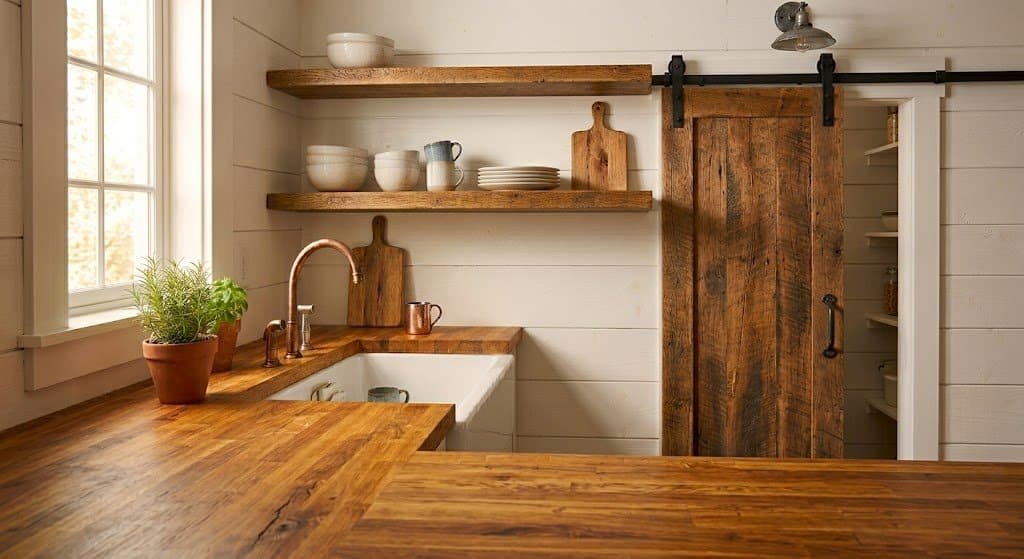
Marble is beautiful. Quartz is practical. But for a modern farmhouse kitchen, nothing — and I mean absolutely nothing — brings warmth and character like butcher block countertops. The natural wood grain, the warm honey tones, the sense that this is a surface that has been used and loved — it speaks to the heart of everything the farmhouse aesthetic is about.When we installed butcher block on our kitchen island, the entire room shifted tonally. Suddenly, everything felt warmer, more cohesive, more alive. The wood picked up the tones in our open shelving, complemented the white shiplap, and gave the space a layered, collected-over-time quality that no manufactured material can replicate.The practical concerns are real: butcher block requires regular oiling (I use a simple food-safe mineral oil every few months), and it can scratch and stain. But here’s the thing — those marks become part of the story. The small knife nick from Thanksgiving prep, the ring from someone’s coffee mug — they are patina, and patina is beautiful in a farmhouse kitchen.If you love the look but want less maintenance, consider using butcher block only on the island while keeping stone or quartz on the perimeter counters. This two-countertop approach is incredibly popular right now and gives you the best of both worlds: practicality where you need it, warmth and beauty where it shows most.
6. Choose Vintage-Inspired Pendant Lights That Make a Statement
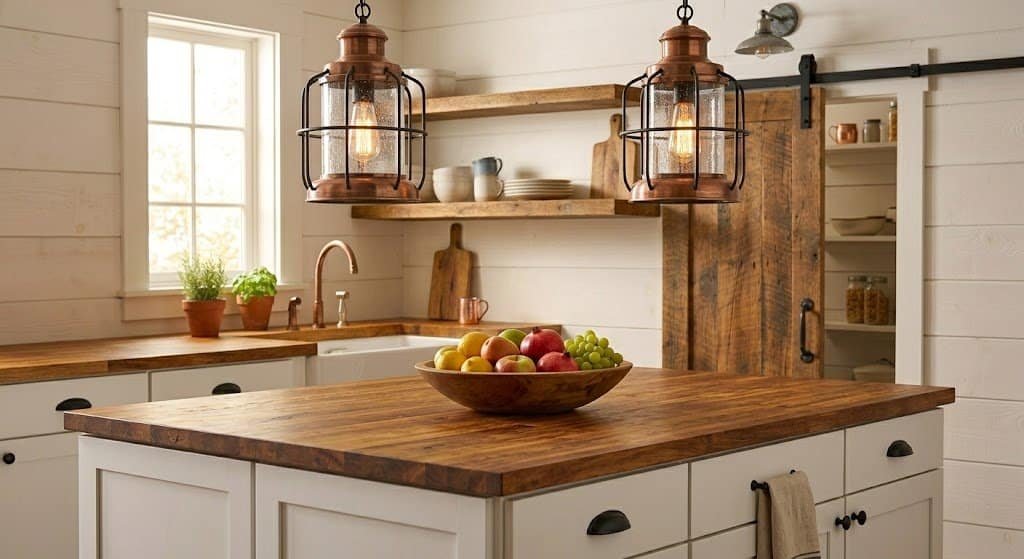
Lighting is the jewelry of a room — and in a farmhouse kitchen, pendant lights are the statement necklace. The right light fixtures can elevate even the most basic kitchen into something that looks pulled straight from an Architectural Digest feature. The wrong ones can undercut every beautiful design decision you’ve made elsewhere.For modern farmhouse kitchens, the most beloved pendant styles fall into a few categories: aged brass or bronze cage pendants with Edison bulbs, black metal wire pendants with warm-toned glass shades, and large rattan or woven pendants that add organic texture. Each creates a slightly different mood — the brass cage reads as refined and a little vintage; the black metal feels more industrial and modern; the rattan is warm, organic, and deeply cozy.Over our kitchen island, we hung three mismatched-but-coordinated pendant lights — all vintage bronze, all with Edison bulbs, but each slightly different in shape. The effect is curated and intentional, not matchy-matchy. It is a small trick that makes a space feel like it has evolved organically over time rather than being purchased all at once from one catalogue.One important practical note: for kitchen islands, hang your pendant lights 30–36 inches above the countertop surface. This is the sweet spot that provides good task lighting without blocking sightlines across the island. If your ceiling is particularly high (9 feet or more), you may want to go slightly lower to keep the lights feeling connected to the space rather than floating up in the ether.
7. Use Classic Subway Tile for a Timeless Backsplash
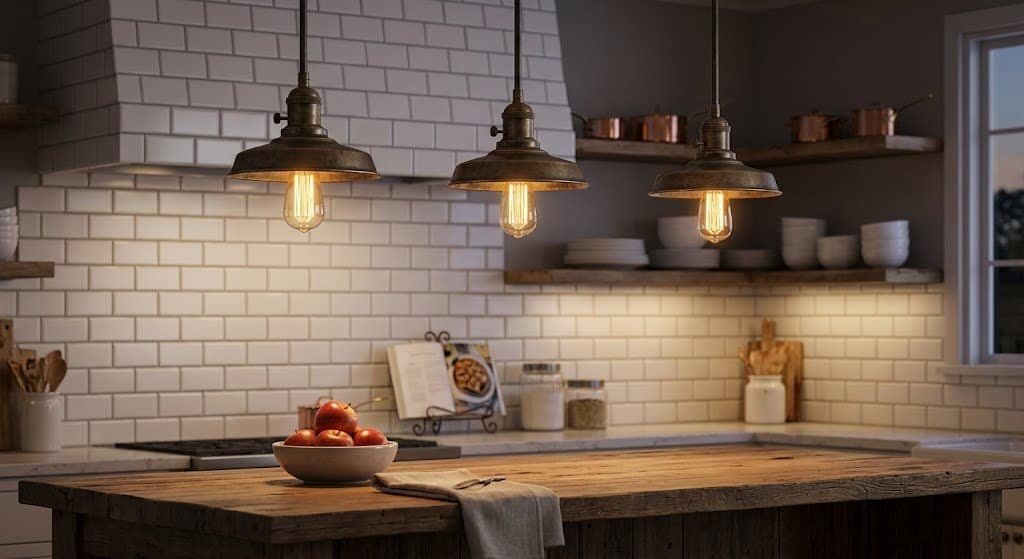
Subway tile has been a design staple since the early 1900s — and it is not going anywhere. In a modern farmhouse kitchen, a well-executed subway tile backsplash strikes the perfect balance between classic and contemporary, clean and warm, simple and beautiful. It is the definition of timeless.The traditional white 3×6 subway tile in a running bond (brick) pattern is always a safe and stunning choice. But if you want to add more personality, consider these variations that work beautifully in farmhouse kitchens: a vertical stack pattern (more modern, more dramatic), a herringbone pattern (more sophisticated, excellent around a range hood), or colored subway tile in soft sage green, dusty blue, or warm cream for a less expected but equally gorgeous result.Grout color matters more than most people realize. White grout gives a seamless, airy look. Light gray grout adds subtle definition without being busy. Dark charcoal or black grout makes the tile pattern pop dramatically and adds a modern edge that is stunning in kitchens with white or cream cabinetry.For installation, subway tile is one of the more DIY-friendly backsplash options if you have the patience and attention to detail. A standard kitchen backsplash can be tiled in a weekend, and the cost of materials is very reasonable — good quality subway tile runs $1.50–$5 per square foot, and a typical kitchen backsplash requires only 30–50 square feet.
8. Embrace a Warm Neutral Color Palette
Color is the foundation that holds every other design decision together — and in modern farmhouse kitchens, the palette follows a clear and beautiful philosophy: warm, soft, natural, and layered. This is not about stark white minimalism. It is about the colors you’d find in a freshly painted country cottage on a warm autumn afternoon.The most successful farmhouse kitchen palettes center on a warm white or cream as the dominant tone (walls, cabinets, ceiling), then layer in natural wood tones (open shelves, butcher block, beams), accent colors in muted, earthy tones (sage green, dusty blue, warm terracotta, soft charcoal), and metal finishes in aged brass, bronze, or matte black.My personal palette recommendation for anyone starting from scratch: walls in Sherwin-Williams “Alabaster” or Benjamin Moore “White Dove,” lower cabinets in a warm greige or soft navy for depth, open shelving in natural walnut or white oak, and hardware and light fixtures in brushed brass. This combination photographs extraordinarily well, works in both natural and artificial light, and has that timeless quality that will not look dated in five years the way trendy colors so often do.The biggest mistake people make in farmhouse kitchens? Going too cool. Cool-toned whites, cool grays, and stainless steel can make a farmhouse kitchen feel sterile and modern in a way that works against the warmth and coziness the style is known for. When in doubt, go warmer. Always go warmer.
9. Decorate with Mason Jars — Practically and Beautifully
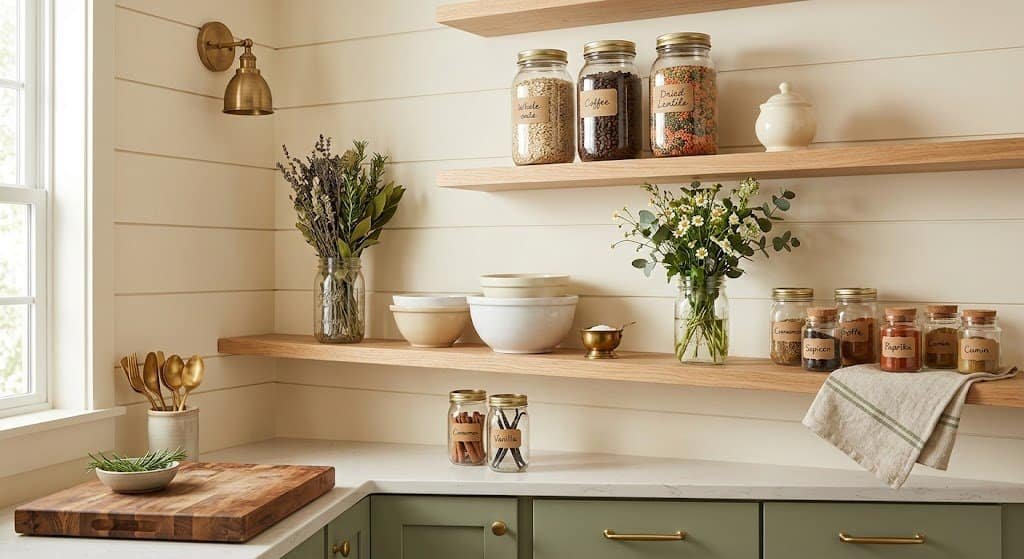
Is there a more universally recognized symbol of farmhouse style than the humble mason jar? These simple glass canning jars have transcended their original purpose to become one of the most versatile and beloved decorative elements in the entire farmhouse design vocabulary. And the best part: they cost almost nothing.In my kitchen, mason jars do at least five different jobs. On the open shelves, large wide-mouth quart jars hold dry goods — pasta, rice, oats, lentils — creating a pantry-display effect that is both practical and beautiful. On the windowsill, small jars hold fresh herbs grown from seeds (basil, mint, rosemary). Hanging on a reclaimed wood board with small metal hooks, half-pint jars hold small utensils. And a cluster of tall jars on the farmhouse sink counter holds dish soap, hand soap, and a small scrubber brush — a little styling trick that makes even the most mundane corner of the kitchen feel intentional.For a special seasonal touch, fill large mason jars with lemons and water for a summer kitchen, with preserved autumn leaves and small pumpkins in fall, or with rosemary sprigs and red berries in winter. The jar stays the same; only the contents change with the seasons. It is one of the easiest and most cost-effective ways to keep your kitchen feeling fresh and current all year long.
10. Expose or Add Ceiling Beams for Architectural Drama
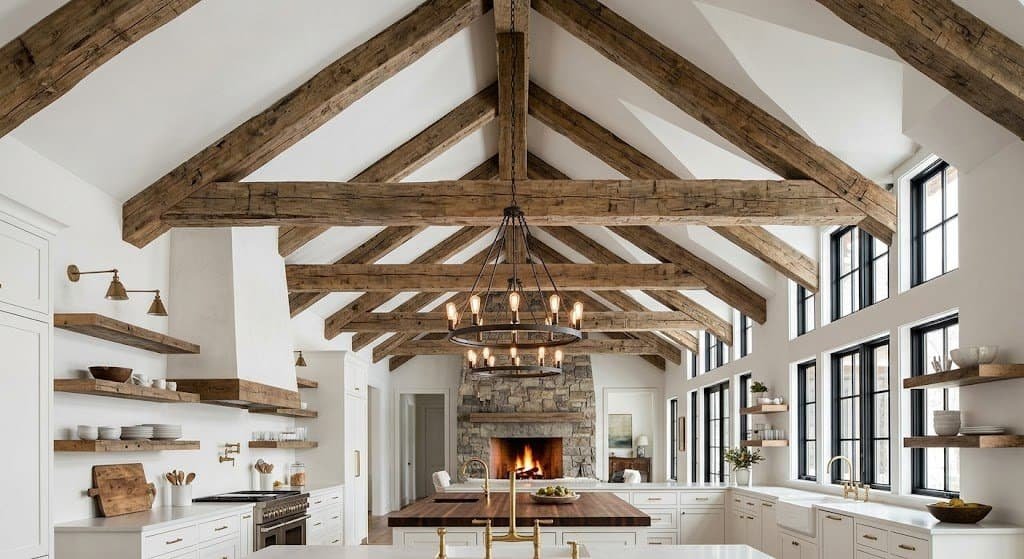
If you have original wood beams in your home and you have painted over them or hidden them behind drywall — please, I am begging you, reveal them. Exposed wood ceiling beams are one of the most spectacular architectural features a farmhouse kitchen can have. They add height, drama, history, and an unmatched sense of character that no amount of decorating can replicate.If your kitchen doesn’t have original beams — which is the case for most of us in standard suburban construction — the good news is that faux beams have become extraordinarily convincing and easy to install. These are lightweight hollow boxes made from real wood veneer or high-density foam that mount to the ceiling on a simple track system. From floor level, they are virtually indistinguishable from the real thing.The most popular finishes for farmhouse kitchen beams are natural stained wood (walnut or oak are particularly gorgeous), whitewashed or weathered gray for a more coastal farmhouse look, or natural unfinished wood with all its knots and grain visible for a fully rustic experience. If you paint your ceiling white and run three or four dark walnut beams across it, the room will gain a vertical dimension that makes it feel taller, grander, and infinitely more interesting.Spacing and scale matter here: in an average-sized kitchen, two to four beams running the length of the ceiling is ideal. Too many beams creates a visually busy, oppressive feeling. Too few and the effect is too subtle to read as intentional. Three beams, evenly spaced, in a kitchen ceiling is almost always exactly right.
11. Replace Cabinet Hardware with Vintage or Antique-Inspired Pieces
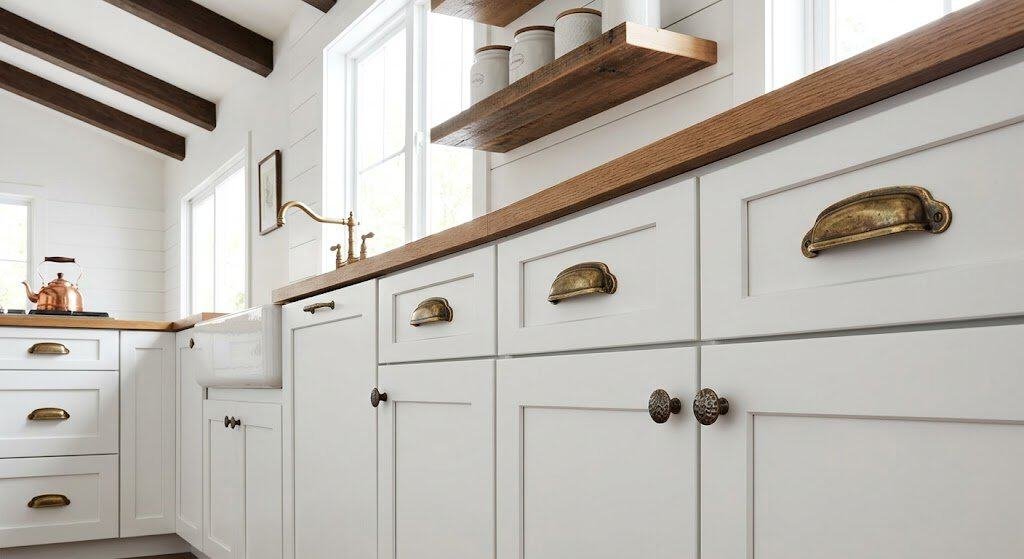
Here is the highest-impact, lowest-cost farmhouse kitchen upgrade you can make: change your cabinet hardware. This is the tip I give every single friend who tells me they want a farmhouse kitchen but doesn’t have the budget for a full renovation. Changing the knobs and pulls on your cabinets and drawers can completely transform the personality of your kitchen in a single afternoon for as little as $50–$150 total.For the modern farmhouse style, the hardware choices that consistently perform best are: cup pulls in aged brass or antique bronze (these are elongated, half-circle shaped pulls with a cup-like curve — classic, beautiful, and extremely functional), bin pulls in aged iron or matte black for a more industrial farmhouse vibe, and simple round ceramic knobs in white or cream with a slightly aged look for a softer, cottage-farmhouse feel.Avoid anything too shiny, too perfectly uniform, or too contemporary. Farmhouse hardware should look like it might have come from an old general store, a grandmother’s kitchen, or an estate sale. That slightly imperfect, slightly aged quality is precisely what makes it feel authentic and special rather than catalog-perfect and sterile.When I changed the hardware in my kitchen — from the standard builder-grade brushed nickel to aged brass cup pulls — the kitchen went from generic to genuinely special. My mother still asks about those drawer pulls every time she visits. They cost $4 each at a local hardware store. That is the power of good hardware.
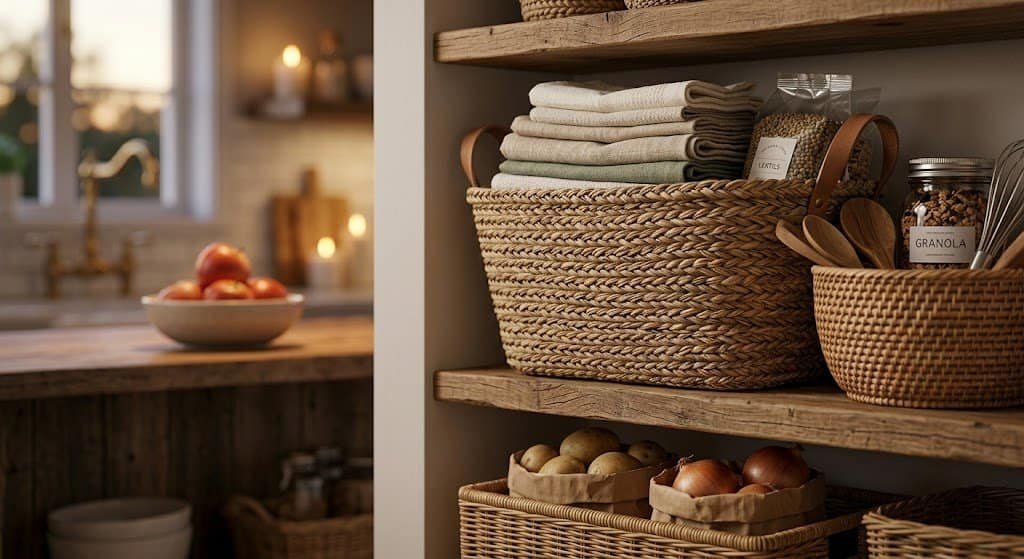
12. Use Woven Baskets for Beautiful, Practical Storage
Woven baskets are to farmhouse kitchens what handbags are to a well-dressed outfit — they add texture, warmth, and personality while serving an entirely practical purpose. And like a great handbag, a beautiful basket at the right scale in the right spot can elevate an entire room.In the kitchen, baskets work beautifully in a number of ways. Large woven baskets underneath open shelves or on the bottom shelf of a kitchen island can hold potatoes, onions, and garlic — keeping them in a cool, dark-ish, ventilated space while looking absolutely charming doing it. Medium-sized baskets on the counter can corral mail, small appliances, or everyday items that tend to create clutter. Small baskets can be used as bread baskets, fruit holders, or even as decorative elements on open shelves alongside your ceramics and glassware.The materials and weave styles that work best in farmhouse kitchens are seagrass, rattan, water hyacinth, and simple natural wicker. Avoid overly crafted, painted, or synthetic baskets — the farmhouse aesthetic lives and breathes through natural, honest materials. The more imperfect, handmade, and organic a basket looks, the more authentically farmhouse it feels.
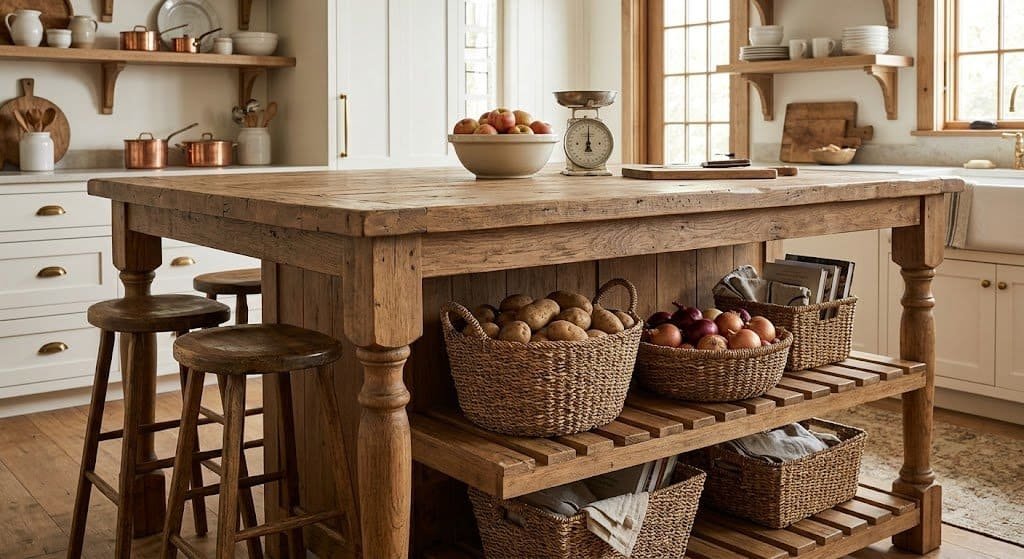
13. Use a Farmhouse Dining Table as a Kitchen Island
This is one of my absolute favorite modern farmhouse design tricks — and it is one that almost nobody else is talking about. Instead of installing a built-in kitchen island, use a vintage or vintage-inspired farmhouse dining table instead. The result is a kitchen that feels genuinely collected, genuinely lived-in, and genuinely beautiful in a way that no standard kitchen island ever achieves.The benefits go beyond aesthetics. A table-as-island gives you more seating flexibility — simply pull up chairs or stools around it for casual dining, homework, or morning coffee. It is removable and movable, which means if you ever want to reconfigure the kitchen, you can. And vintage farmhouse tables — with their chunky legs, worn wood tops, and slightly imperfect proportions — have a character and warmth that no manufactured island can match at any price point.Look for old farm tables at estate sales, antique markets, and online marketplaces. A solid wood farmhouse table that needs some refinishing can often be found for $100–$300 and transformed with a little sandpaper and some tung oil into a spectacular kitchen focal point. Pair it with mismatched vintage stools — another farmhouse-approved design choice — and you have a kitchen that looks like it was styled by a professional.
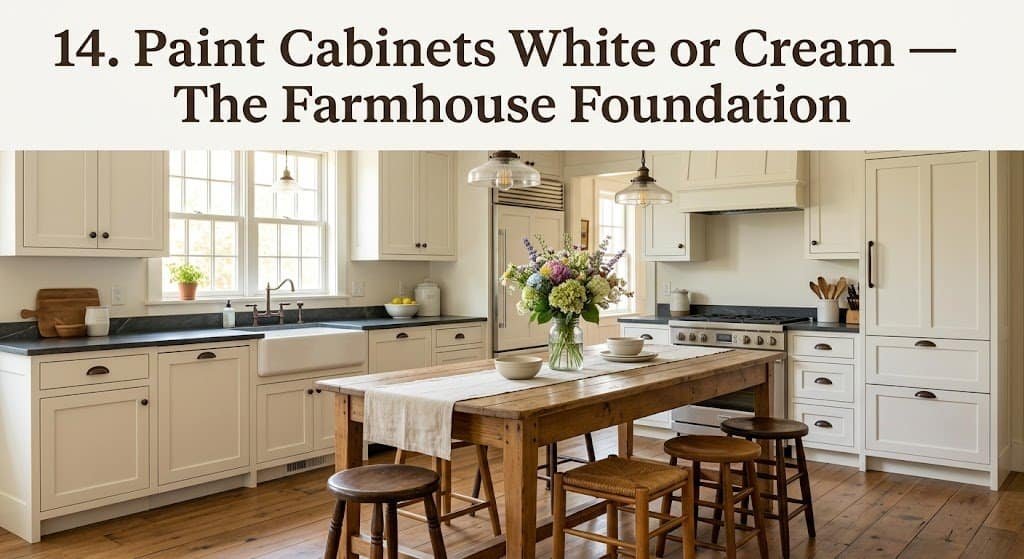
14. Paint Cabinets White or Cream — The Farmhouse Foundation
White or cream painted cabinets are the single most transformative change you can make to move a kitchen toward the farmhouse aesthetic, and they are far more achievable as a DIY project than most people realize. When I painted our existing oak cabinets — yes, painted them, rather than replacing them — the kitchen went from 1990s builder-grade to genuinely beautiful almost overnight.The key is preparation and paint selection. For cabinets that will stand up to daily use and look great for years, you need to: clean thoroughly with a degreaser, sand lightly to create adhesion, use a high-quality bonding primer, and finish with a cabinet-specific paint in either semi-gloss or satin finish. Benjamin Moore Advance is widely considered the gold standard for cabinet painting — it self-levels beautifully to minimize brush marks and cures to an incredibly hard, durable finish.For a truly modern farmhouse look, consider painting upper cabinets white or cream and lower cabinets in a deeper, more saturated tone — navy, hunter green, charcoal, or a warm terracotta. This two-tone approach adds depth and sophistication, prevents the all-white kitchen from feeling flat or clinical, and is one of the biggest trends in farmhouse kitchen design right now.If you’re not ready to paint all your cabinets, start with just one section — perhaps the island, or a single bank of lower cabinets — and see how it transforms the space before committing to the full project.
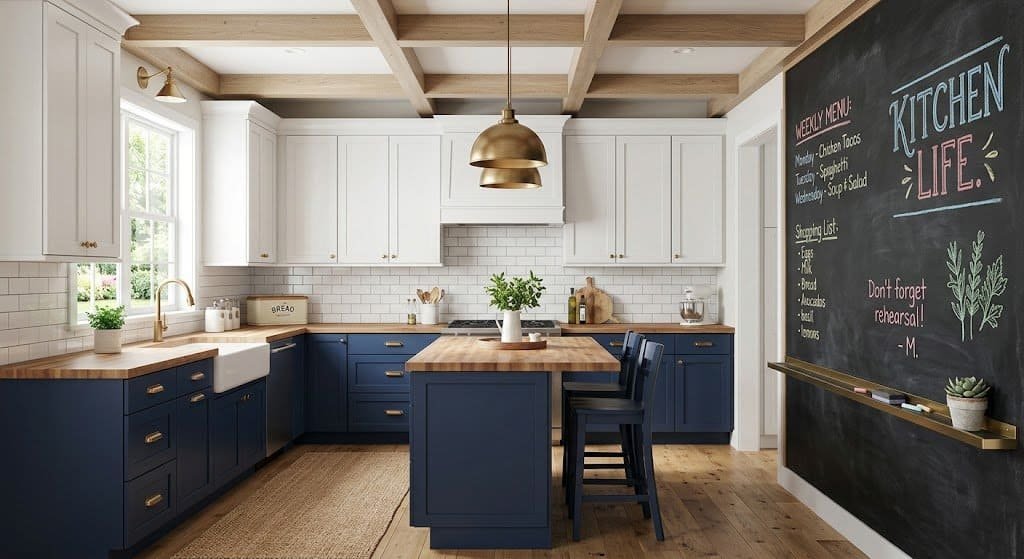
15. Install a Chalkboard Wall or Panel for Functional Farmhouse Charm
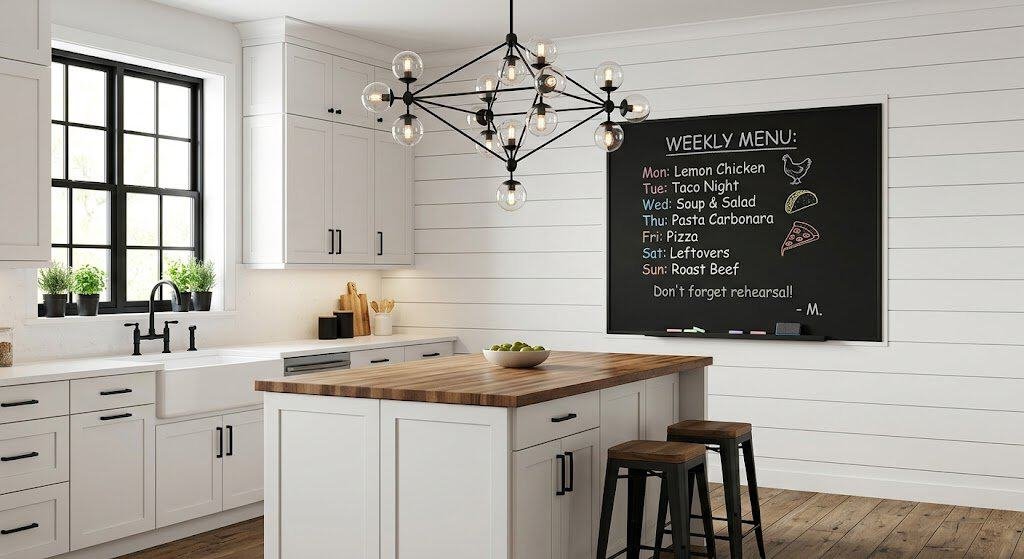
A chalkboard element in a farmhouse kitchen is one of those ideas that sounds a little too cute until you actually live with it — and then you wonder how you ever managed without it. A chalkboard wall, panel, or even a simple framed chalkboard hung on the wall brings the farmhouse kitchen to life with a functionality that no other decor element can match: it is genuinely useful every single day.In our kitchen, we have a medium-sized framed chalkboard panel hung beside the refrigerator. On a typical week, it holds the weekly meal plan (Monday: pasta, Tuesday: soup…), a running grocery list, a few motivational words my daughter writes each Sunday morning, and whatever seasonal greeting feels right — “Hello, November” or “Happy Summer” in her unmistakable twelve-year-old handwriting. It is the most human, most personal thing in our kitchen, and I love it more than almost anything else in the room.For implementation, you have several options: paint an entire wall (or a section of wall) with chalkboard paint, have a piece of sheet metal or plywood cut to size and painted with chalkboard paint, or simply buy a framed chalkboard from a home goods store. The frame makes a significant difference aesthetically — a distressed wood frame, a simple black metal frame, or even an ornate vintage frame all work beautifully in a farmhouse kitchen context.
16. Add Matte Black Accents for a Modern Edge
This is the element that transforms a kitchen from simply farmhouse to specifically modern farmhouse — and it is one of the most important distinctions to understand. The “modern” in modern farmhouse isn’t just an aesthetic modifier; it is a deliberate design philosophy that uses contemporary finishes and clean lines to prevent the style from tipping over into full country-cottage or antique-store territory.Matte black is the primary tool for this balancing act. Matte black faucets, light fixtures, cabinet hardware, window frames, and decorative accessories create a graphic, contemporary contrast against warm whites, natural woods, and soft ceramics that is both striking and perfectly calibrated. It says: this is a farmhouse kitchen, but it is a farmhouse kitchen in the 21st century.When I switched our kitchen faucet to a matte black bridge faucet (a style with two separate handles and a bridge connector between them — a particularly farmhouse-appropriate silhouette), the whole kitchen gained a sophistication it had been slightly missing. The black anchored the space, gave it visual weight, and made every warm wooden element nearby look richer and more intentional by contrast.A few important notes on using black in a farmhouse kitchen: keep it consistent across all metal elements in the room (don’t mix matte black with brushed nickel or polished chrome), use it as an accent rather than a dominant color, and always balance black with plenty of warm, soft elements so the kitchen retains its coziness rather than reading as cold or severe.
17. Bring in Greenery and Fresh Kitchen Herbs
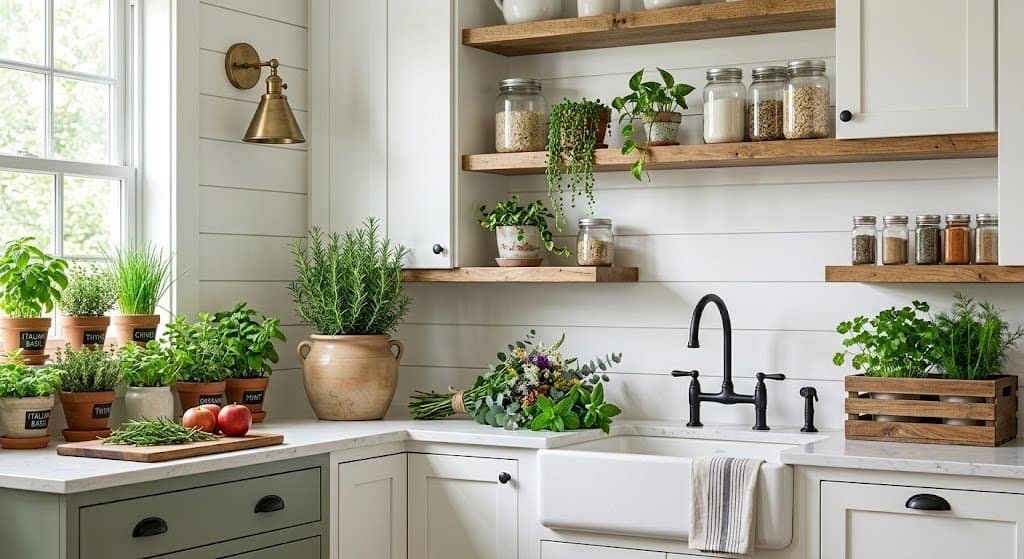
Plants belong in every room of a beautiful home, but in the kitchen — especially a farmhouse kitchen — they do something particularly magical. They bring the outside in, they soften hard surfaces and sharp edges, they introduce natural color and fragrance, and they remind you in the most direct possible way that food is a living, growing thing that comes from the earth.The most farmhouse-appropriate approach to kitchen greenery is also the most practical: grow fresh herbs in small pots on your windowsill or on a dedicated small shelf near a light source. Basil, mint, rosemary, thyme, chives, and cilantro are all easy to grow indoors and devastatingly beautiful in small terracotta pots or simple white ceramic planters. And of course, you can use them — fresh herbs in a farmhouse kitchen that you actually snip and cook with is living the dream in the most literal and satisfying sense.Beyond herbs, consider a trailing pothos or philodendron on the top of open shelving — their long, lush vines draping down over dishes and jars add a wildly beautiful organic quality that no other decor element can duplicate. A small eucalyptus bundle hung on a cabinet knob, a bunch of dried lavender in a ceramic vase, or a simple fiddle leaf fig in a woven basket on the kitchen floor — all are perfect farmhouse kitchen plant choices that work beautifully together or individually.
18. Create a Cozy Breakfast Nook in a Corner or Bay Window
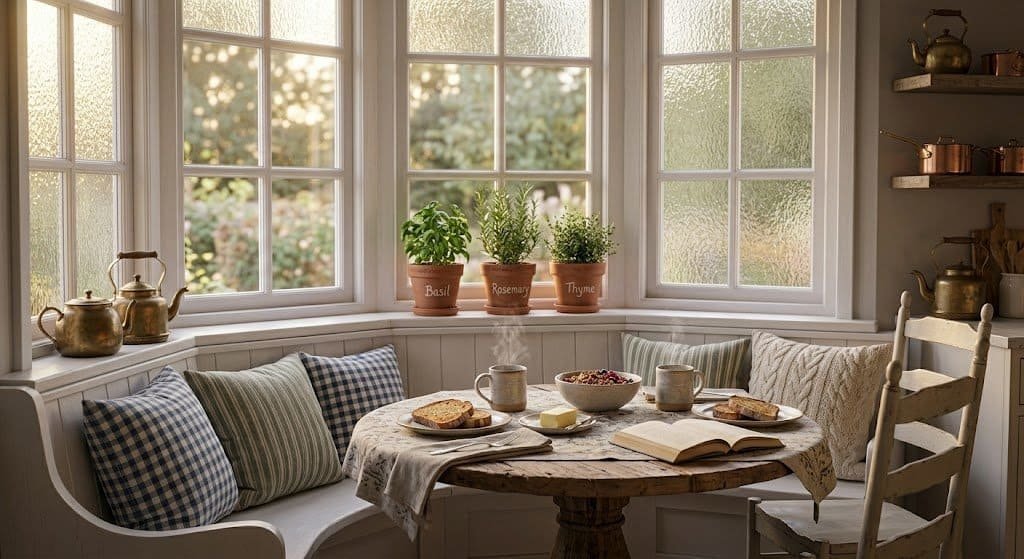
If I could redesign any single part of my kitchen, it would be to add a proper breakfast nook. A built-in bench seat tucked into a corner or nestled in a bay window, with a farmhouse-style table and mismatched cushions and throw pillows — it is one of the most universally cozy and beloved spaces in all of home design, and in a farmhouse kitchen it reaches its absolute apex.The breakfast nook works on a functional level because it creates a dedicated, intimate space for morning coffee, casual family meals, homework, and conversation — separate from the main cooking and food-prep area but still connected to the heart of the home. On a design level, it gives you a contained, beautifully decorable space where you can layer textures, patterns, and colors in a way that would feel overwhelming at kitchen scale but feels perfectly proportioned and inviting at nook scale.For the farmhouse breakfast nook, the essentials are: a simple plank-top table (painted white or natural wood), a built-in bench or banquette with a simple storage base (the hollow interior is perfect for storing extra linens, seasonal items, or board games), and cushions and pillows in linen, cotton, or gingham in classic farmhouse tones — cream, sage, dusty blue, warm terracotta. Add a small pendant light overhead, a few framed botanical prints on the wall behind the bench, and a small vase of flowers on the table — and you have created a space that people will not want to leave.
19. Layer Natural Textures — Linen, Cotton, Wood, and Stone
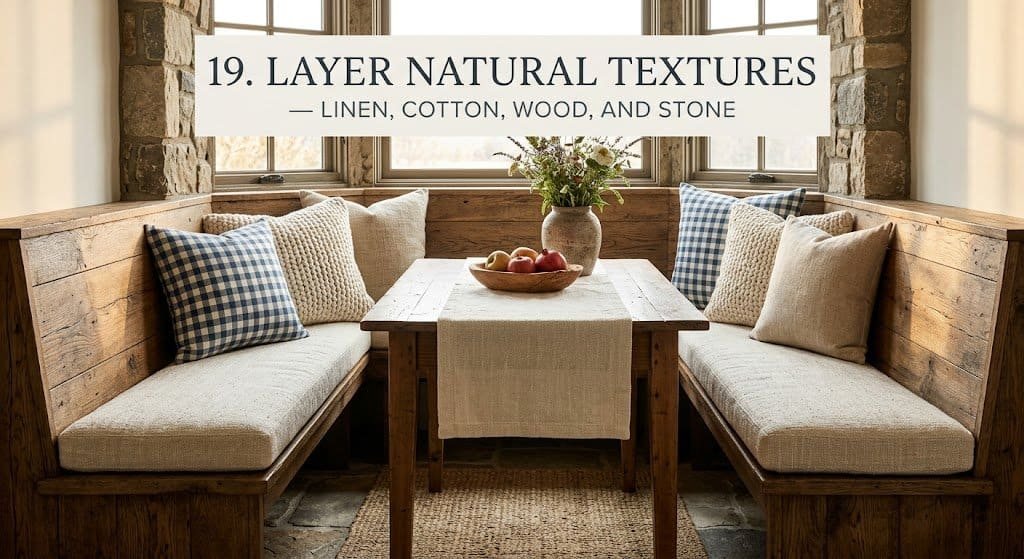
One of the things that most clearly separates a beautifully designed farmhouse kitchen from one that merely has farmhouse elements is the layering of textures. Texture is what makes a space feel rich and complex, warm and tactile, real rather than staged. In a farmhouse kitchen, the goal is to build up layers of natural, honest, imperfect textures that reward closer inspection and feel genuinely wonderful to be around.Think about the different surfaces in your kitchen and ask yourself: is there a mix of hard and soft, smooth and rough, shiny and matte? A perfect farmhouse kitchen layering might look like this: smooth white shiplap walls + rough-hewn wood shelves + matte ceramic dishes + a linen tea towel draped over the oven handle + a woven basket on the counter + the slightly pitted surface of an old farmhouse table + the cool solidity of a stone or marble pastry board + the warm glow of brass hardware. Each element contributes a different textural note to a rich, harmonious composition.Soft goods are the easiest and most affordable way to add texture quickly. Linen tea towels, cotton dish cloths, a simple runner rug in jute or wool on the kitchen floor, cushions on bar stools — these are small additions that collectively make an enormous difference to how warm and layered a space feels. Change them seasonally to keep the kitchen feeling fresh throughout the year without any major investment.
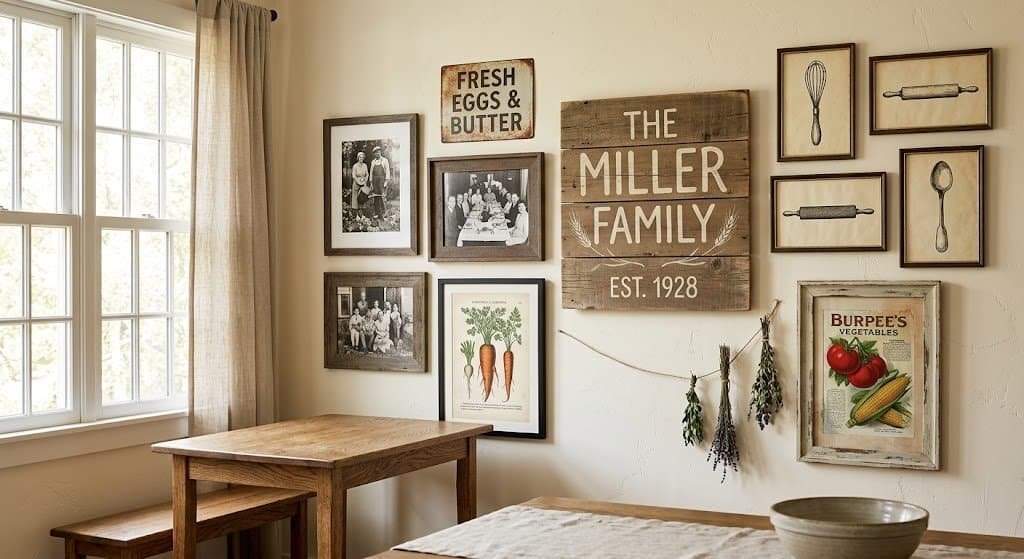
20. Display Vintage Signs and Handmade Wall Art
Final Thoughts: Your Farmhouse Kitchen Story Is Just Beginning
Looking back on that 11 PM Pinterest session three years ago, I am so grateful we had the courage to start. Our kitchen renovation was not linear or perfect — there were wrong turns, a tile order that came in the wrong size, a barn door that took three weekends to hang properly because we kept finding studs in the wrong places. But every imperfection, every small frustration and triumphant breakthrough, became part of the story of this kitchen.And that is, I think, the deepest truth of the farmhouse aesthetic: it is not about achieving a perfect magazine-ready result. It is about creating a space that feels warm, real, personal, and alive — a kitchen where people want to gather, where food is made with love, and where every corner holds something that was chosen with care and intention.You don’t need to do all 20 of these ideas at once. Pick one. Do it this weekend. See how it changes the room — and more importantly, see how it changes the way you feel about your home. That single change might be all the encouragement you need to begin the beautiful, ongoing project of creating the kitchen you have always wanted.I would love to hear which of these ideas you’re most excited about trying. Leave a comment below, or tag me on Pinterest when your farmhouse kitchen transformation is underway. I cannot wait to see what you create.
About the Author: I am a home decor enthusiast, Pinterest content creator, and self-taught kitchen renovator who transformed a dated suburban kitchen into a modern farmhouse dream on a real-world budget. I share honest, detailed, experience-based home decor advice for real families in real homes.
Read More: 17 large blank living room wall ideas